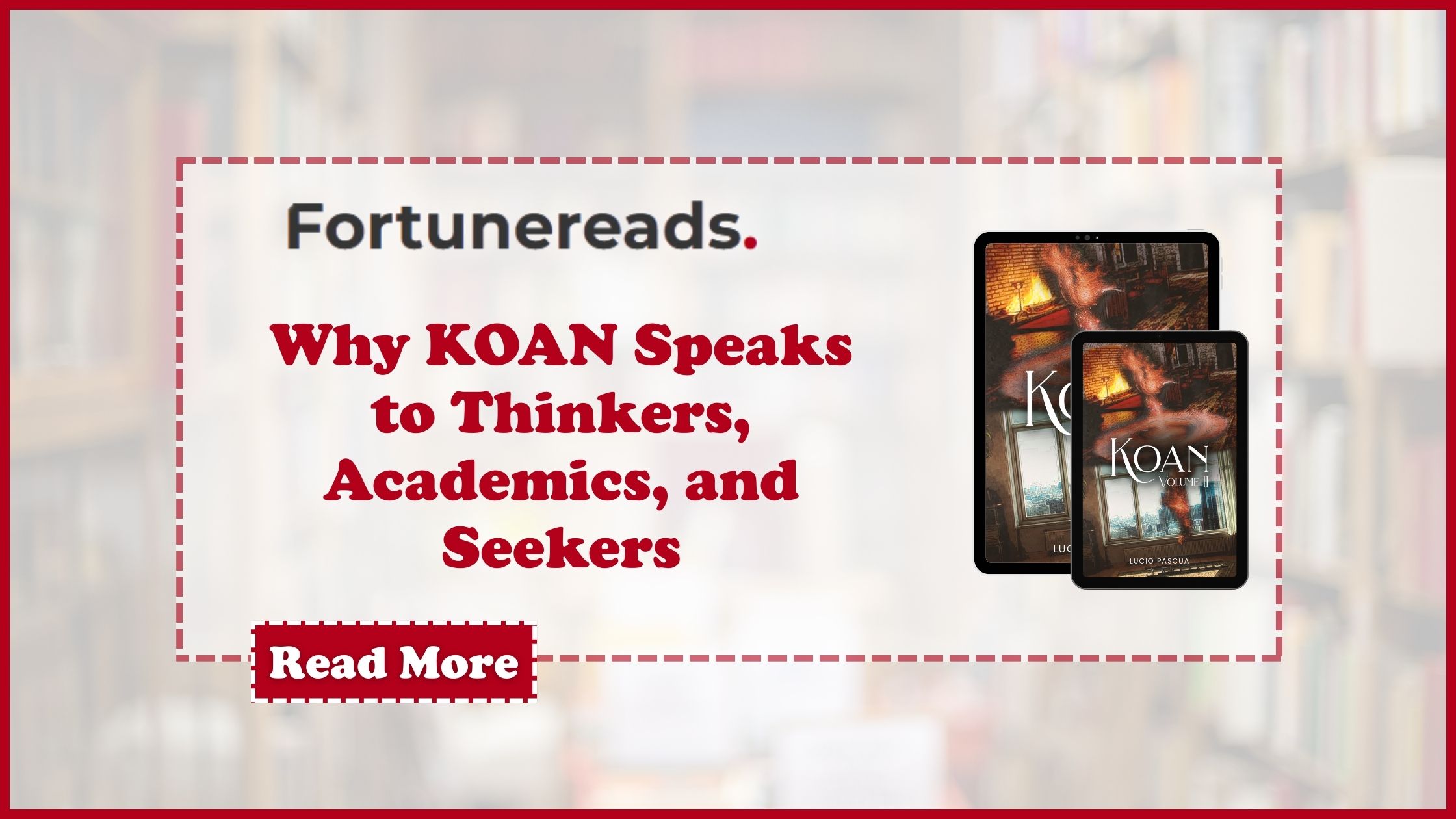
Some books move quickly and entertain for a moment. Others slow the reader down and ask for attention, patience, and thought. KOAN by Lucio Pascua belongs firmly in the second group. From the first pages, the novel signals that it is not designed for rushed reading or easy conclusions. Instead, it invites readers to sit with ideas, observe patterns, and reflect on how stories shape understanding. That is why the book speaks so strongly to thinkers, academics, and spiritually curious readers.
At its core, KOAN is not driven by a single hero or a simple conflict. The book unfolds as a layered journey that blends philosophy, myth, science, and quiet humor. Readers encounter symbolic figures, imagined societies, and moments that feel more like reflections than plot turns. For scholars and philosophers, this structure encourages analysis rather than consumption. The book rewards close reading, comparison, and interpretation, making it well-suited for discussion in academic and literary settings.
One reason KOAN resonates with academics is its openness. Lucio Pascua does not tell the reader what to believe or how to interpret the ideas presented. Instead, the book raises questions about order and chaos, power and restraint, and the nature of consciousness. For example, the presence of the Enlightened One and the Guardians can be read through multiple lenses. A philosopher may see metaphors for ethical balance, while a student of religion may connect them to spiritual traditions. A scientist or science-minded reader may reflect on how the book treats reality as layered and uncertain. This openness positions the book as ideal for scholars, philosophers, and spiritually curious readers, emphasizing its value for discussion, re-reading, and interdisciplinary analysis.
The book also speaks to seekers because it treats curiosity with respect. KOAN does not mock spiritual questions or reduce them to simple answers. It allows doubt, wonder, and uncertainty to coexist. Characters often reflect on their roles, choices, and the systems within which they live. These moments resonate with readers who question authority, identity, or the direction of modern life. Rather than offering comfort through certainty, the book offers companionship through shared questioning.
For book clubs and classrooms, KOAN offers engaging material for discussion. One reader may focus on its political ideas, particularly its approach to nonviolence and leadership. Another may be drawn to its satire of institutions like science or religion. Others may focus on its narrative style, which blends poetic language, humor, and allegory. Each reading experience can lead to a different discussion, making the book rich without being overwhelming.
KOAN is best approached with time and an open mind. It is a book to read slowly, return to, and talk about with others. For readers who enjoy thinking across disciplines and exploring big questions through story, this novel offers a thoughtful and rewarding experience.
If you are looking for fiction that invites reflection rather than distraction, KOAN by Lucio Pascua is well worth reading.
Head to Amazon to purchase your copy of KOAN.
Koan: Volume l (The Koan Saga Book 1): https://www.amazon.com/dp/1968615466
Koan: Volume ll (The Koan Saga Book 2): https://www.amazon.com/dp/1968615474