The line between fiction and reality has never felt narrower. Political thrillers, once seen purely as entertainment, are now being read with a different kind of attention. Readers are no longer asking whether these stories are exciting. They are asking how close they are to the truth.
This shift reflects the world we live in. Political landscapes are evolving rapidly, global tensions are rising, and unexpected events continue to reshape societies. In such an environment, political thrillers offer something that traditional reporting often cannot. They provide a broader narrative, one that connects scattered developments into a cohesive and compelling vision.
What makes political thrillers so powerful today is their ability to capture patterns. While news reports focus on immediate events, fiction explores trajectories. It asks where current decisions might lead and what consequences could emerge over time. This forward looking approach allows authors to present scenarios that feel less like imagination and more like projection.
Readers are drawn to this sense of realism. They recognize elements of their own world within these stories, whether it is political division, strained international relationships, economic uncertainty, or social unrest. These are not distant or abstract ideas. They are part of everyday life, and political thrillers bring them into sharper focus.
At the heart of this genre is tension, not just between characters, but between systems, ideologies, and nations. Power struggles, hidden agendas, and shifting alliances drive the narrative forward. Yet what makes these stories resonate is their grounding in reality. The conflicts may be dramatized, but their foundations are unmistakably real.
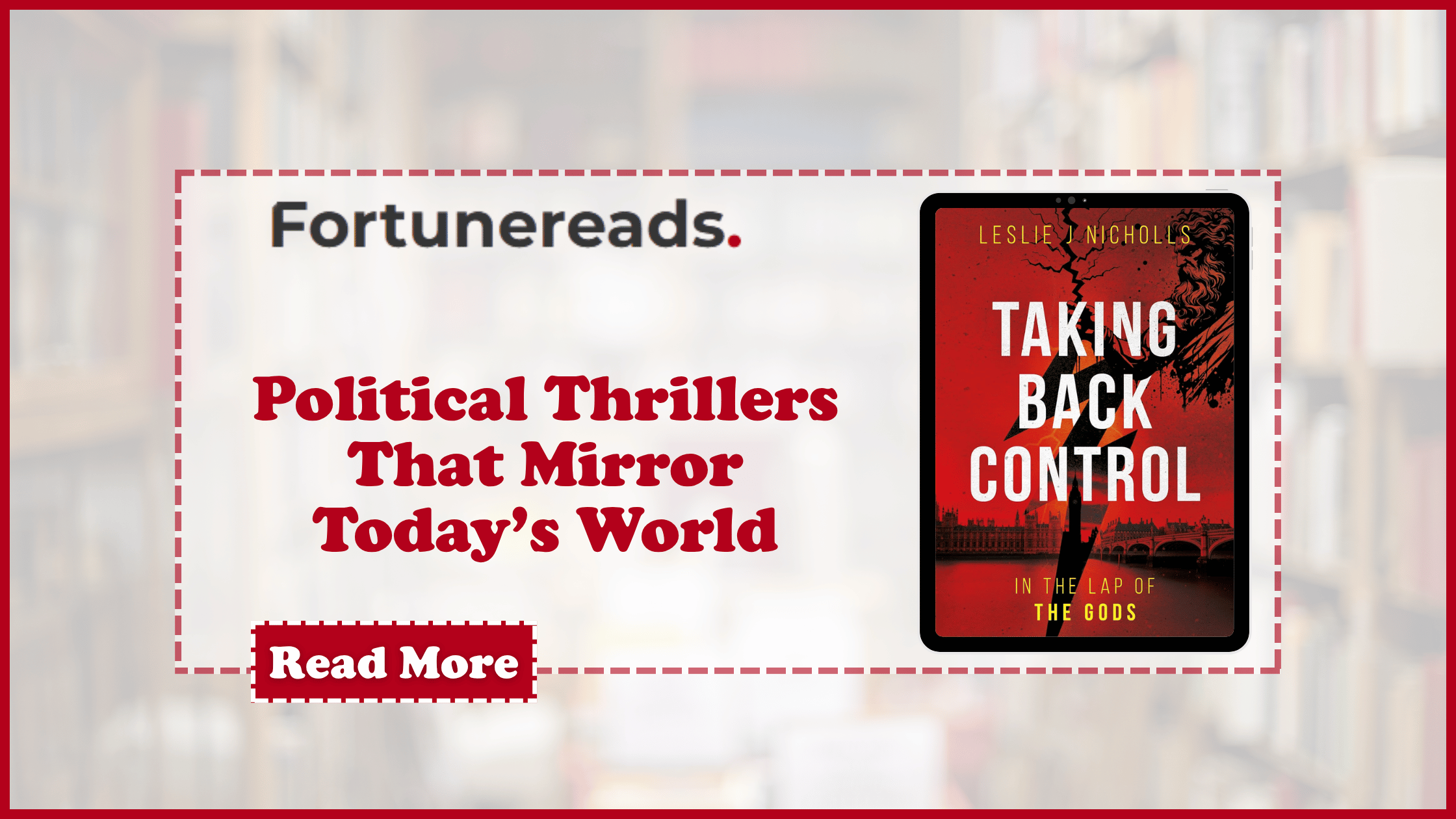
Few authors embody this approach as effectively as Leslie J Nicholls. His work stands as a clear example of how political thrillers can mirror the world with striking precision. Through The Disunited Kingdom series and his standalone novels, Nicholls explores themes that closely align with current global developments. His narratives delve into political fragmentation, economic instability, and the complex web of international relations that defines modern society.
What distinguishes his writing is its sense of authenticity. The scenarios he presents do not feel exaggerated. Instead, they unfold in a way that feels entirely plausible. This is where the true impact lies. When readers find themselves thinking, this could happen, the story moves beyond fiction and becomes something more meaningful.
Nicholls also understands the human dimension of political change. His characters are not distant observers. They are directly affected by the forces shaping their world. This perspective adds depth to the narrative, showing how large scale events influence individual lives. It creates a connection that draws readers deeper into the story and encourages them to reflect on their own reality.
Another reason political thrillers are gaining relevance is their ability to address complex issues without overwhelming the reader. Topics such as geopolitical strategy, economic policy, and ideological conflict can be difficult to engage with in traditional formats. Fiction translates these ideas into experiences, making them more accessible and easier to understand.
As global uncertainty continues, the demand for stories that reflect and interpret reality is growing. Political thrillers meet this demand by offering both insight and engagement. They entertain, but they also provoke thought. They encourage readers to look beyond headlines and consider the broader implications of what is happening around them.
In this context, the work of Leslie J Nicholls is particularly significant. His books do not just tell stories. They hold a mirror to the world, revealing patterns and possibilities that might otherwise go unnoticed. For readers seeking more than surface level narratives, his writing offers a compelling and thought provoking experience.
Political thrillers are no longer confined to fiction shelves as simple escapism. They have become a lens through which readers can examine the present and contemplate the future. And in that role, they are more relevant than ever.
Explore the full story here: https://www.amazon.com/dp/B0G4F2KTJC.