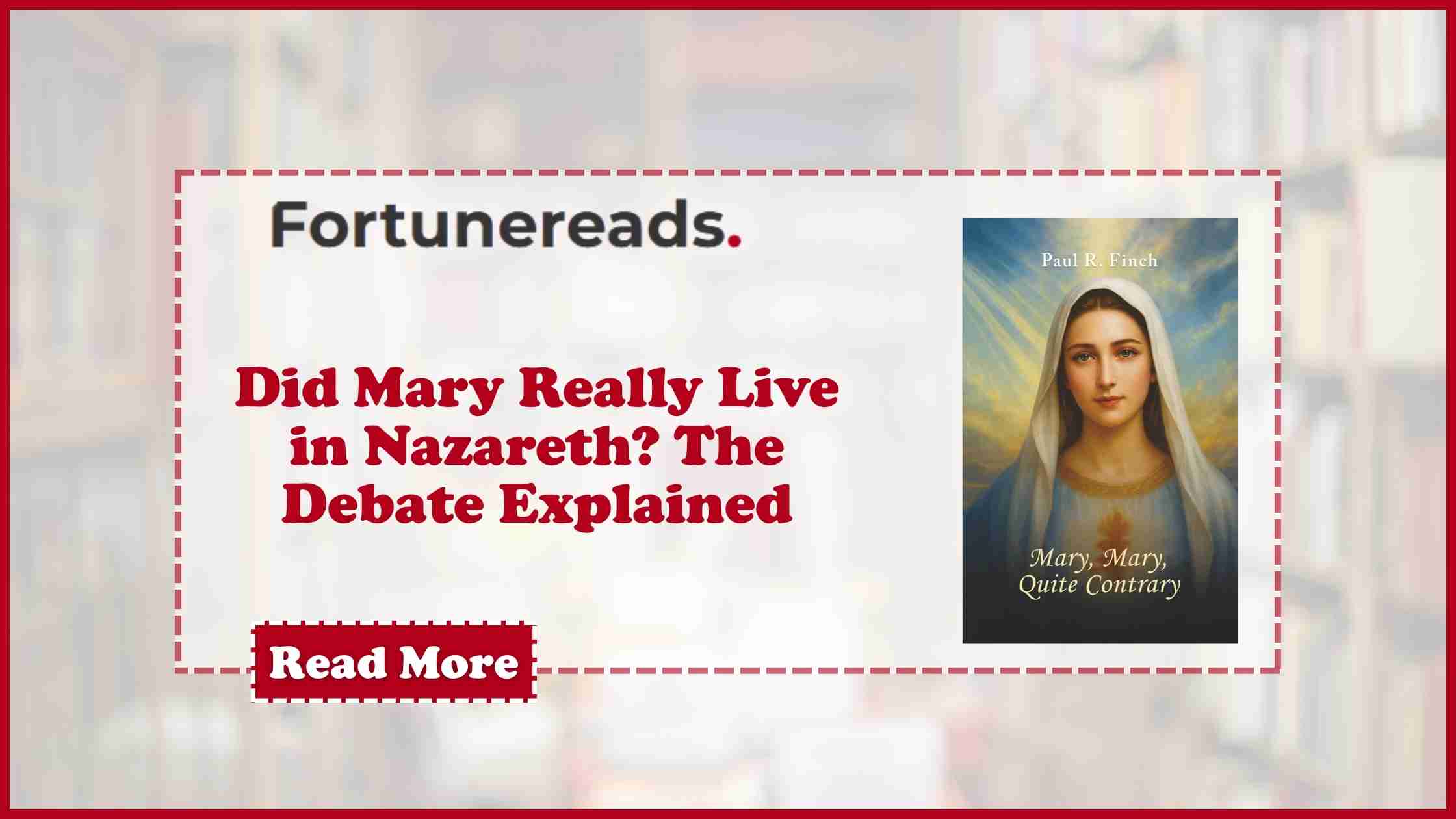
The question seems mundane. Mary, the mother of Jesus, lived in Nazareth. That is what most people have been taught. It is repeated in sermons, depicted in art, and embedded in tradition. Yet when the sources are examined closely, the answer becomes far less certain.
The association with Nazareth comes primarily from the Gospel of Luke, which places Mary there at the time of the angelic announcement. This detail has shaped centuries of belief. Nazareth becomes her home, her identity, and the setting for one of the most significant moments in Christian history.
When compared with other sources, both canonical and non-canonical, a different picture begins to emerge. The Gospel of Matthew does not emphasize Nazareth in the same way. Instead, its narrative places greater weight on Bethlehem, particularly in connection with Joseph’s residence and the early life of Jesus. In this account, Nazareth appears later, almost as a relocation rather than an original home.
This raises an important question. If Mary was truly from Nazareth, why does one account seem unaware of that detail while another highlights it so strongly?
The debate dives deeper when additional writings are considered. Some early texts suggest that Mary’s life was closely connected to Jerusalem and the Temple. These accounts describe a setting where her upbringing and daily life were tied to religious structures rather than a distant village in Galilee. If this perspective holds any historical weight, it challenges the assumption that Nazareth was her primary home.
Geography also plays a role in this discussion. Nazareth was a small and relatively obscure settlement during the first century. It is notably absent from many historical records of the time. This has led some researchers to question whether its prominence in later tradition reflects its actual significance during Mary’s life.
Another factor is narrative development. Over time, stories tend to become simplified and unified. Details from different accounts are combined into a single, coherent version that is easier to understand and teach. In this process, complex or conflicting elements are often smoothed over. The result is a familiar narrative that may not fully reflect the diversity of the original sources.
The idea that Mary lived in Nazareth may therefore be less a definitive historical fact and more a conclusion shaped by one dominant account. This does not mean it is incorrect. It means it is not beyond question.
What emerges from this discussion is not a clear replacement answer, but a recognition of uncertainty. Mary’s exact place of residence may not be as firmly established as tradition suggests. Instead, it sits at the intersection of differing narratives, each offering its own perspective.
This uncertainty invites a broader reflection. How many accepted details in well-known stories are based on selective emphasis rather than complete evidence? And how often are alternative possibilities overlooked simply because they fall outside the familiar version?
Exploring these questions does not diminish the significance of the story. It adds depth to it. It encourages a closer reading of the texts and a willingness to consider perspectives that have long remained in the background.
Mary, Mary, Quite Contrary: New Insights into the Mother of Jesus by Paul R. Finch examines questions like this with careful attention to both established texts and lesser known accounts. By bringing these perspectives together, the book offers a deeper and more layered understanding of Mary’s life and the world in which her story unfolded.
Get Your Copy On Amazon: https://www.amazon.com/dp/1971002372/