For centuries, manual labor has been the foundation of economic progress and human survival. From agriculture and construction to manufacturing and logistics, physical work has defined not only industries but also identity, culture and social structure. Yet we are now entering a period where this long-standing relationship between humans and labor is undergoing a profound transformation.
Artificial intelligence (AI) and robotics are rapidly reshaping the nature of work. What once required human strength, repetition and endurance is increasingly being performed by autonomous machines capable of operating with precision, speed and consistency beyond human limits. From robotic assembly lines in manufacturing to AI-driven logistics systems and autonomous construction equipment, the physical demands of labor are steadily being transferred from humans to machines.
This shift does not simply represent technological progress; it signals a fundamental redefinition of what it means to work, contribute and find purpose in society.
In this emerging reality, we are witnessing the gradual end of manual labor as a dominant human function. But what comes next is far more complex than job displacement. It is the beginning of a new human identity.
For generations, identity has been closely tied to occupation. A person was defined by what they built, transported, repaired or cultivated. Work provided structure, dignity and meaning. But as automation reduces the need for human physical labor, society must confront a difficult question: Who are we when our hands are no longer required in the same way?
This is not a dystopian prediction; it is an evolving reality already visible across industries. Autonomous systems now handle tasks that were once physically demanding and hazardous. Construction sites deploy AI-guided machinery that can operate continuously with minimal human oversight. Warehouses rely on robotic systems to manage inventory with extraordinary efficiency. Even emergency response operations are increasingly supported by drones and autonomous units that reduce human exposure to danger.
While these advancements significantly improve safety and productivity, they also raise a deeper concern: the displacement of human participation from the physical world of work.
The implications extend beyond economics. As manual labor declines, so too does a traditional source of identity and purpose. This transition introduces new psychological and social challenges, including uncertainty about professional relevance, reduced physical engagement and the potential loss of shared cultural experiences built around work.
At the same time, new opportunities are emerging. The workforce is shifting toward roles that emphasize supervision, system design, digital literacy and human-machine collaboration. In this evolving landscape, human value is no longer defined by physical output but by creativity, adaptability, ethical reasoning and emotional intelligence.
However, this transition must be carefully managed. Without intentional frameworks, the shift from manual labor to automated systems could deepen inequality and create a divide between those who adapt to new technologies and those who are left behind. It could also lead to a broader societal challenge: the erosion of purpose in a world where work no longer serves as the primary anchor of identity.
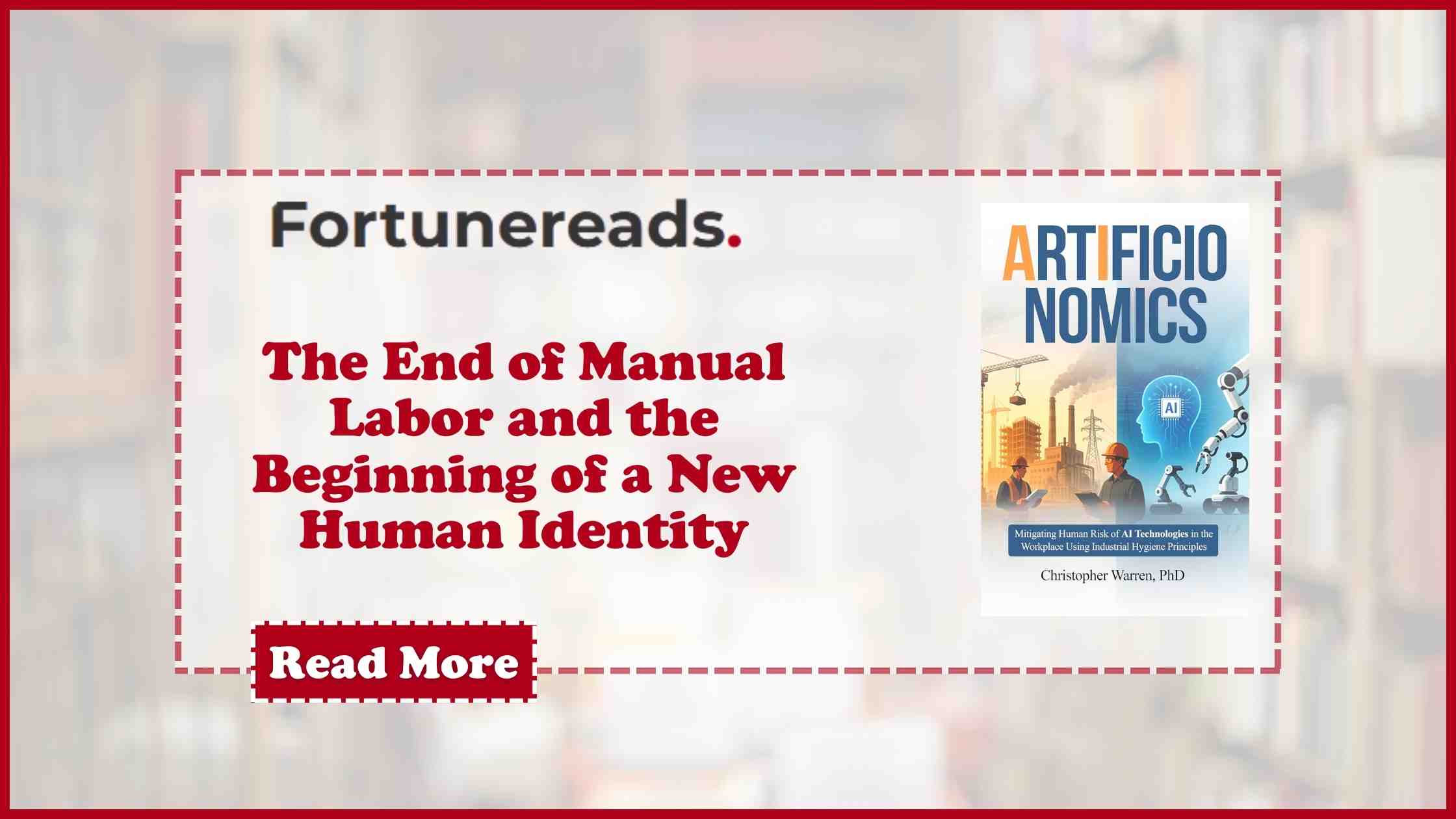
This is where ArtificIonomics, developed by Christopher Warren, provides a critical lens for understanding and navigating this transformation. ArtificIonomics is a new discipline that applies industrial hygiene principles to the risks introduced by artificial intelligence and robotics in the workplace. It expands traditional safety thinking beyond physical hazards to include psychological, cognitive and ethical dimensions of human experience.
Rather than viewing automation solely as a replacement for human labor, ArtificIonomics reframes it as a system that must be designed with human well-being at its core. It emphasizes the need to identify not only physical risks but also emotional displacement, cognitive overload and identity disruption caused by rapidly evolving work environments.
Global research supports the urgency of this shift. Organizations such as the World Economic Forum have highlighted the massive labor transitions underway, with automation expected to reshape millions of jobs globally. Meanwhile, studies from McKinsey & Company warn that without proper adaptation strategies, workers may face increasing levels of stress, disengagement and economic uncertainty.
Yet within this disruption lies an opportunity.
The end of manual labor does not have to mean the end of meaningful work. Instead, it can mark the beginning of a new human identity, one rooted not in physical repetition, but in innovation, oversight, creativity and ethical stewardship of intelligent systems. Humans may move from being operators of machines to designers of meaning, guiding the purpose and direction of technological systems that now perform the physical tasks of industry.
This evolution requires a shift in mindset. It requires organizations, policymakers and safety professionals to rethink how work is structured, how value is measured and how human dignity is preserved in automated environments.
Ultimately, the future will not be defined by the disappearance of manual labor alone, but by what replaces it in the human experience. If designed thoughtfully, this transition can elevate humanity into roles that are more creative, strategic and fulfilling than ever before.
This is the central promise of ArtificIonomics: a framework for ensuring that as machines take on the burden of physical labor, humans are not left behind but are instead redefined in ways that preserve purpose, dignity and identity in the age of intelligent automation.
Available On Amazon: https://www.amazon.com/dp/B0GFY4RL6B/