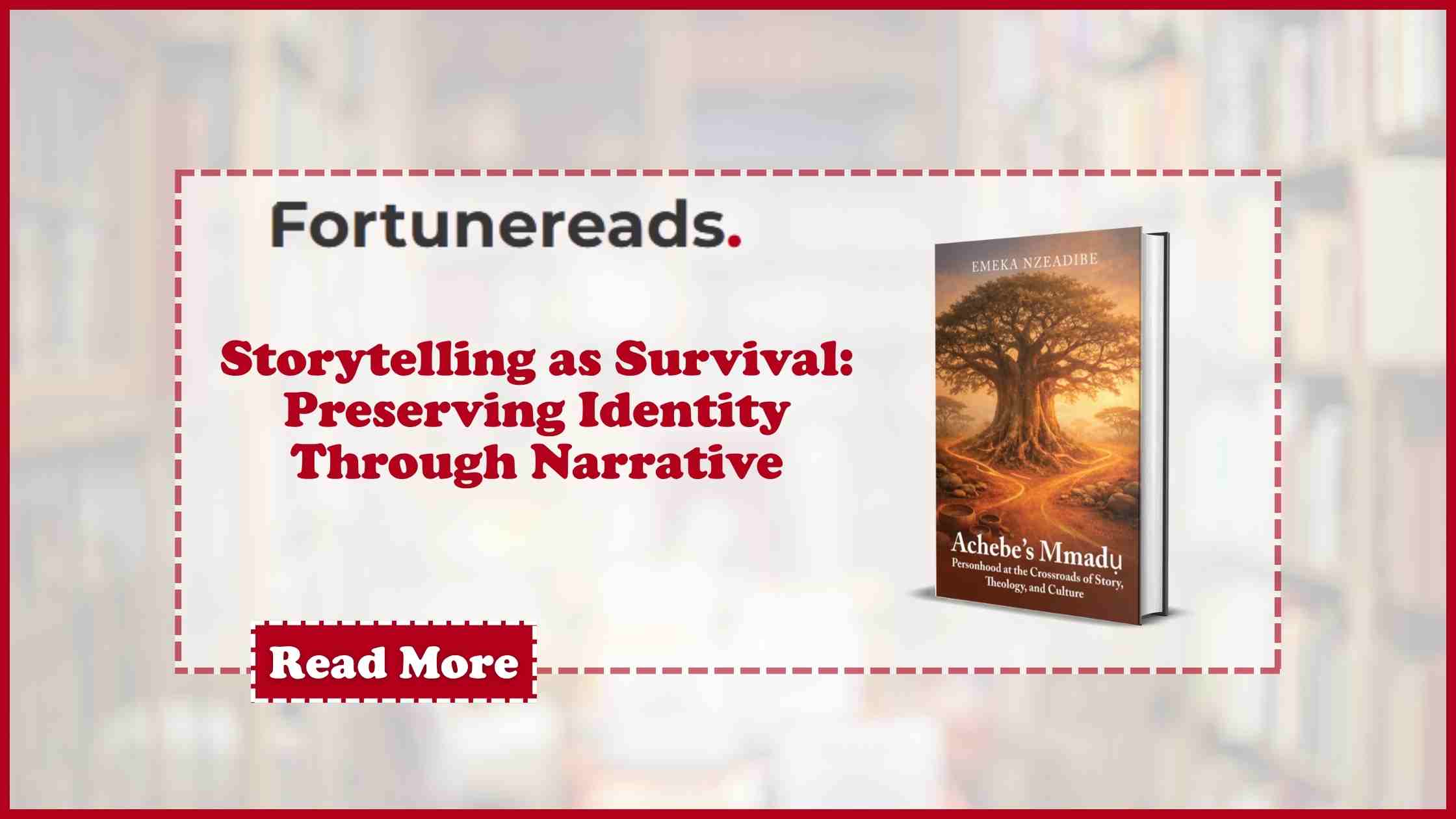
Long before written records, identity lived in stories. It moved through voices, memory, and shared experience, carrying meaning across generations. In many cultures, storytelling was never a simple act of entertainment. It was preservation, resistance, and continuity. Within the rich framework explored in Achebe’s Mmadụ: Personhood at the Crossroads of Story, Theology, and Culture by Emeka Nzeadibe, storytelling emerges as one of the most powerful tools for sustaining identity in the face of disruption.
When a people lose their stories, they lose more than history. They lose the language through which they understand themselves. Narrative shapes how individuals see their place in the world, how communities remember their past, and how values are transmitted over time. Without it, identity fragments. With it, identity survives.
Storytelling carries the weight of lived experience. It encodes cultural knowledge, moral insight, and collective memory in forms that remain accessible and enduring. Through narrative, complex ideas about life, belonging, and purpose are not abstract concepts but embodied realities. They are seen in characters, heard in proverbs, and felt in moments of conflict and resolution. In this way, stories do not simply describe identity. They create and sustain it.
The significance of storytelling becomes even clearer in moments of cultural disruption. When external forces challenge established ways of life, narratives become a means of resistance. They preserve what cannot be easily erased. They hold onto meaning when structures begin to shift or collapse. Through storytelling, a community retains its voice even when it is pressured to adopt another.
This is where the work of Chinua Achebe gains its enduring power. His narratives do not only recount events. They restore a worldview. They present a living, breathing cultural reality that speaks for itself rather than being interpreted from the outside. In doing so, storytelling becomes an act of reclaiming identity. It refuses silence and challenges distortion.
Achebe’s Mmadụ: Personhood at the Crossroads of Story, Theology, and Culture takes this further by showing how narrative is tied directly to the understanding of the human person. Identity is not static. It unfolds through stories that connect individuals to their community, their history, and their sense of purpose. Through storytelling, the human person is not reduced to a fixed definition but revealed as part of an ongoing narrative.
Stories also create continuity. They bridge the past and the present, ensuring that knowledge is not lost but carried forward. Each retelling reinforces connection. Each listener becomes a future storyteller. This cycle sustains identity across time, allowing it to adapt without losing its core.
There is also a deeper dimension to narrative. Stories do not only preserve what has been. They shape what is to come. They influence how individuals act, what they value, and how they respond to challenges. In this sense, storytelling is not passive. It is formative. It guides behavior and frames possibility.
In a world where identity is often shaped by rapid change and external influence, the role of storytelling remains vital. Without strong narratives, individuals risk losing connection to their roots. Communities risk losing coherence. Stories provide grounding. They offer a sense of direction in environments that may otherwise feel uncertain or fragmented.
What makes Achebe’s Mmadụ: Personhood at the Crossroads of Story, Theology, and Culture essential reading is its ability to show that storytelling is not merely cultural expression. It is a structure of survival. It reveals how narrative holds together the threads of identity, even under pressure. It demonstrates that to understand who we are, we must understand the stories we tell and the stories that have shaped us.
Storytelling does not simply preserve identity. It ensures that identity continues to live, evolve, and endure.
For More Details: https://www.librarything.com/profile/EmekaNzeadibe