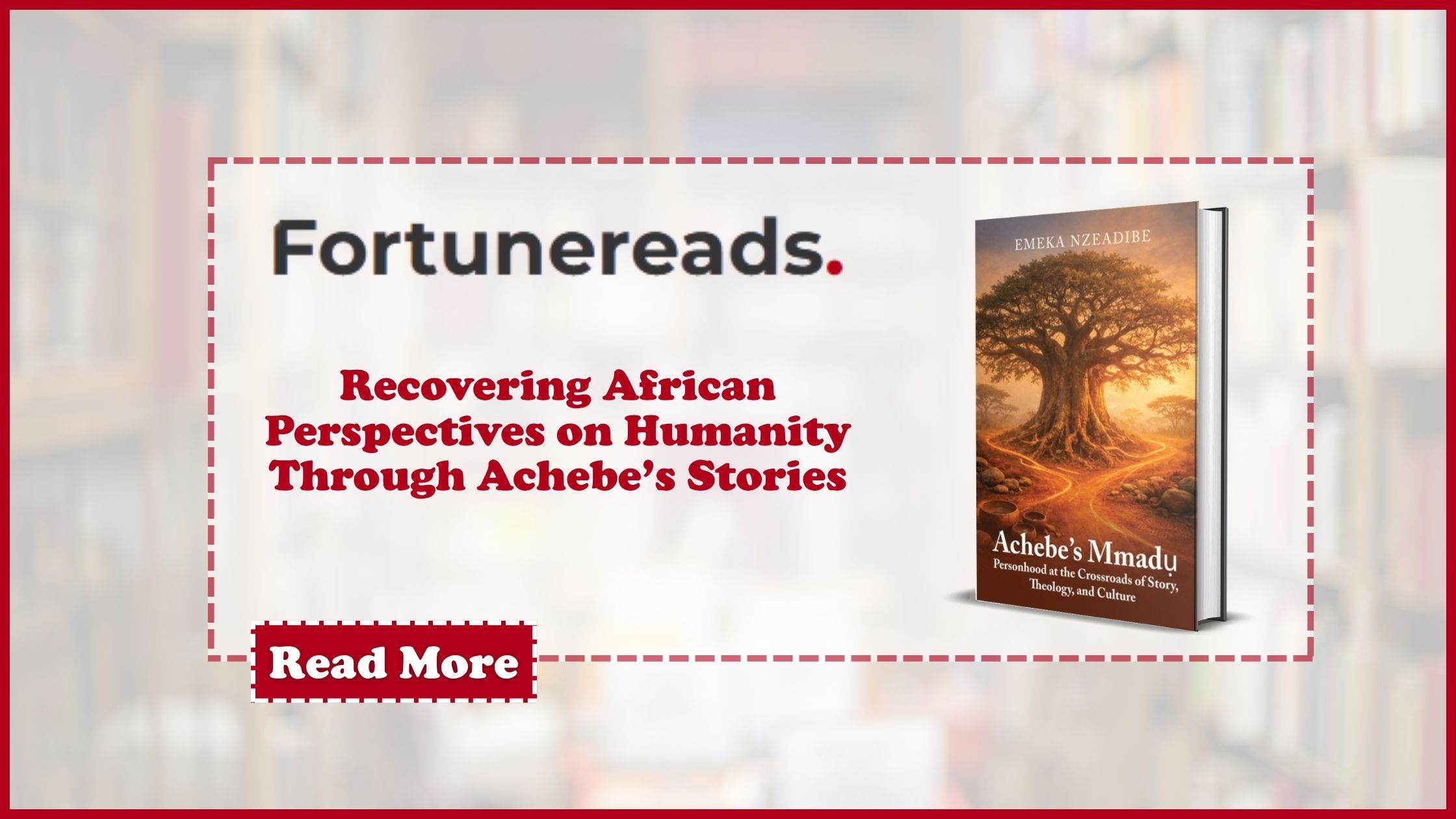
For generations, many discussions about humanity, personhood and dignity have been shaped mainly by Western philosophical and theological traditions. While those traditions remain important, they do not represent the full range of human thought. In Achebe’s Mmadụ: Personhood at the Crossroads of Story, Theology, and Culture, Emeka Nzeadibe turns to Chinua Achebe’s literary world to recover an African perspective on what it means to be human.
At the center of the book is the Igbo concept of Mmadụ. The term can mean a human being or person, but its significance reaches much further. It includes identity, consciousness, subjectivity, dignity and relationship. Nzeadibe presents Mmadụ as someone who exists not in isolation, but within a living network that includes family, community, ancestors, culture, the natural world and the divine.
Achebe’s stories provide the imaginative space in which this understanding becomes visible. His novels do not merely describe Igbo customs or preserve memories of precolonial life. They reveal how people understand themselves, make choices, experience responsibility, respond to change and struggle with the tension between personal identity and communal belonging.
Through characters such as Okonkwo and Ezeulu, Achebe shows that African societies are not simple or uniform. They contain conflict, contradiction, hierarchy, wisdom, vulnerability, spiritual conviction and moral uncertainty. This complexity matters because colonial narratives often portrayed African people as if they lacked history, philosophy or meaningful social institutions. Achebe’s storytelling challenges those distortions by presenting African characters as fully human, neither idealised nor reduced to stereotypes.
Nzeadibe builds on this literary achievement by showing how Achebe’s work contains philosophical and theological insight. Mmadụ is not only a cultural label. It is a framework for understanding the human person as both individual and relational. A person belongs to a community, but does not disappear within it. The concept of Chi, associated with personal identity, destiny and spiritual uniqueness, protects the individuality of each human being even within a strongly communal world.
This balance gives the book particular relevance today. Modern life often pulls people toward two extremes: radical individualism on one side and the loss of personal identity within political, cultural or social groups on the other. Achebe’s Mmadụ offers a more integrated vision. Human beings become themselves through relationships, yet their dignity cannot be reduced to social approval, status, success or usefulness.
The book also places Igbo thought in conversation with Christian theology, especially the concept of imago Dei or humanity created in the image of God. This dialogue does not erase cultural difference. Instead, it shows how African intellectual traditions can deepen global conversations about dignity, responsibility, freedom and belonging.
Storytelling is essential to this recovery. Stories preserve memory, restore silenced voices and allow communities to describe themselves rather than being defined by outsiders. For Nzeadibe, Achebe’s narratives become vessels of personhood, carrying culture, identity, moral reflection and spiritual meaning across generations.
Achebe’s Mmadụ invites readers to encounter African thought not as a supplement to “universal” ideas, but as a vital source of insight in its own right. Through Achebe’s stories, Emeka Nzeadibe recovers a vision of humanity rooted in dignity, relationship, spiritual depth and the enduring power of culture.
Read the book on Amazon: https://a.co/d/0363OG8A