For most people, the phrase “U.S.-China conflict” brings to mind tariffs, trade restrictions, semiconductor controls, diplomatic disagreements or arguments over Taiwan. These issues may seem serious, but still far removed from actual warfare.
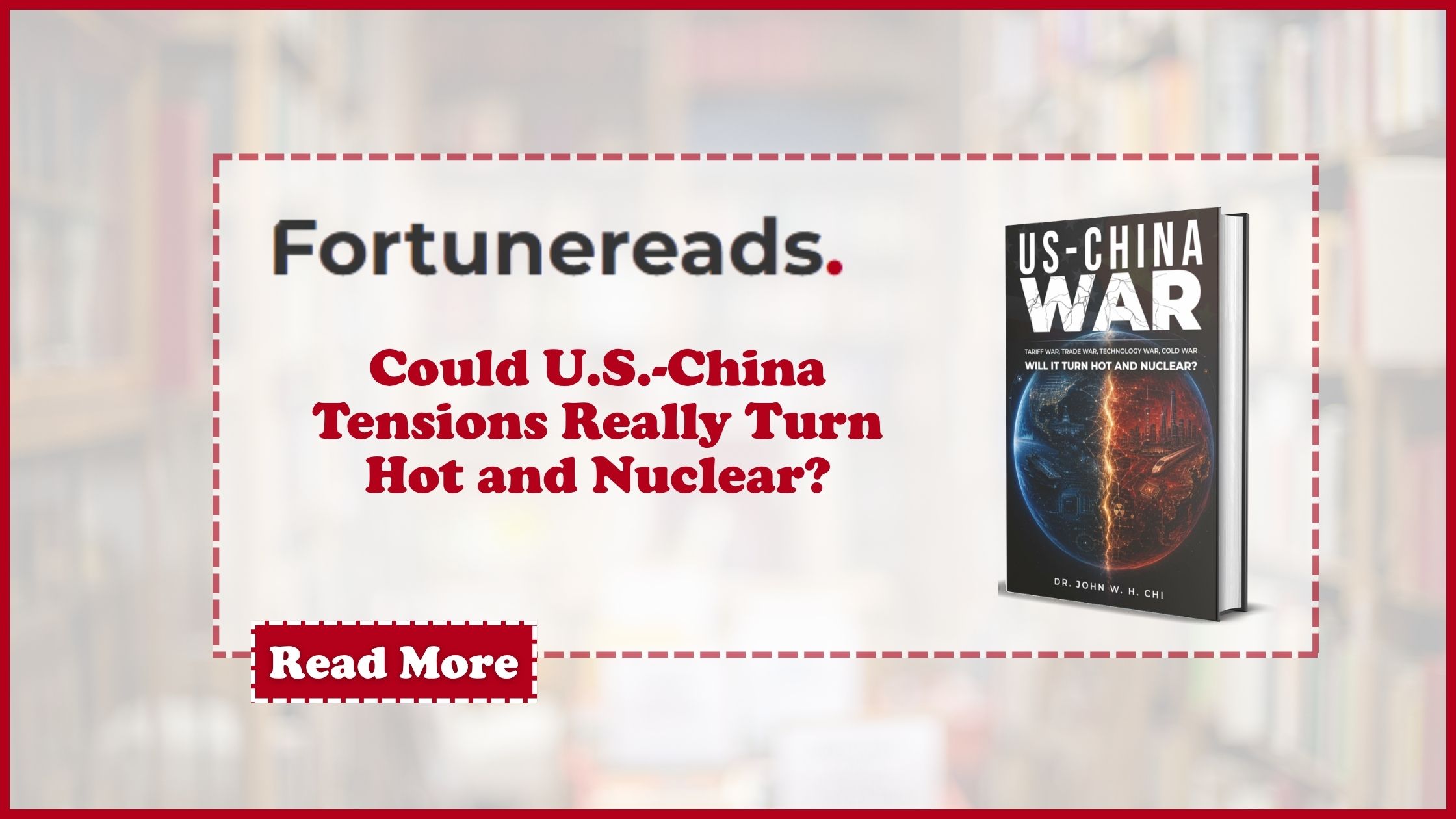
Dr. John W. H. Chi’s US-China War: Will It Turn Hot and Nuclear? asks readers to consider a much more unsettling possibility: What if today’s economic and political rivalry keeps escalating until military confrontation becomes possible?
The book frames the progression as a direct tariff war, trade war, technology war, Cold War and then asks whether the next stage could become hot and nuclear.
That question gives the book its urgency.
The Rivalry Is No Longer Just About Trade
Dr. Chi argues that competition between the United States and China has expanded far beyond imports and exports.
His book explores sanctions, high-technology restrictions, semiconductor controls, military alliances, ideological conflict, geopolitical competition and efforts to contain China’s economic and technological rise. It also examines how Washington’s relationship with Beijing changed as China developed into a major manufacturing, scientific and technological power.
In Dr. Chi’s view, these pressures are all connected.
He sees them as signs of a broader strategic struggle over influence, security, economic power and the future international order.
That becomes especially dangerous when military issues enter the picture.
Taiwan Raises the Stakes Dramatically
A major portion of US-China War focuses on Taiwan, which Dr. Chi presents as one of the most serious potential flashpoints between Washington and Beijing.
The book discusses U.S. military activity in the Asia-Pacific, alliances around China, naval operations, arms sales to Taiwan and political actions that Beijing considers provocative. Dr. Chi argues that such developments increase the possibility of miscalculation and escalation.
A confrontation over Taiwan would not involve two minor military powers.
It would involve the United States and China, two countries with enormous armed forces, advanced missile capabilities, global economic importance and nuclear weapons.
That is what makes the question in the book’s title so disturbing.
Nuclear War Is Not an Abstract Concern
Dr. Chi writes about nuclear risk from an unusual professional perspective.
During his 29-year career at Westinghouse Electric Corporation, he worked on national-defense projects and became chief designer of space nuclear power reactors associated with President Reagan’s Strategic Defense Initiative.
His technical background gives added weight to his concern about escalation between nuclear powers.
The book also contrasts the nuclear policies of China and the United States, including China’s stated no-first-use policy and the U.S. position of reserving the possibility of first use.
For Dr. Chi, the danger is not necessarily that either side actively wants nuclear war. The danger lies in rivalry, provocation, military buildup, fear and miscalculation creating circumstances that become increasingly difficult to control.
Is There Another Path?
Despite its alarming title, US-China War: Will It Turn Hot and Nuclear? is ultimately a book advocating peace rather than predicting inevitable destruction.
Its concluding discussion emphasizes peaceful coexistence, mutual respect, cooperation and careful management of disagreements. It presents the idea that both nations benefit from cooperation and both lose from confrontation.
That message may be the book’s most important takeaway.
Dr. Chi challenges readers to look beyond political slogans and daily headlines and think seriously about what continued escalation could mean.
The question is not simply whether the United States or China can gain an advantage.
It is whether two powerful nations can learn to compete without creating a conflict whose consequences could reach the entire world.
Discover Dr. John W. H. Chi’s US-China War: Will It Turn Hot and Nuclear? https://www.amazon.com/dp/B0HC8TJT28/