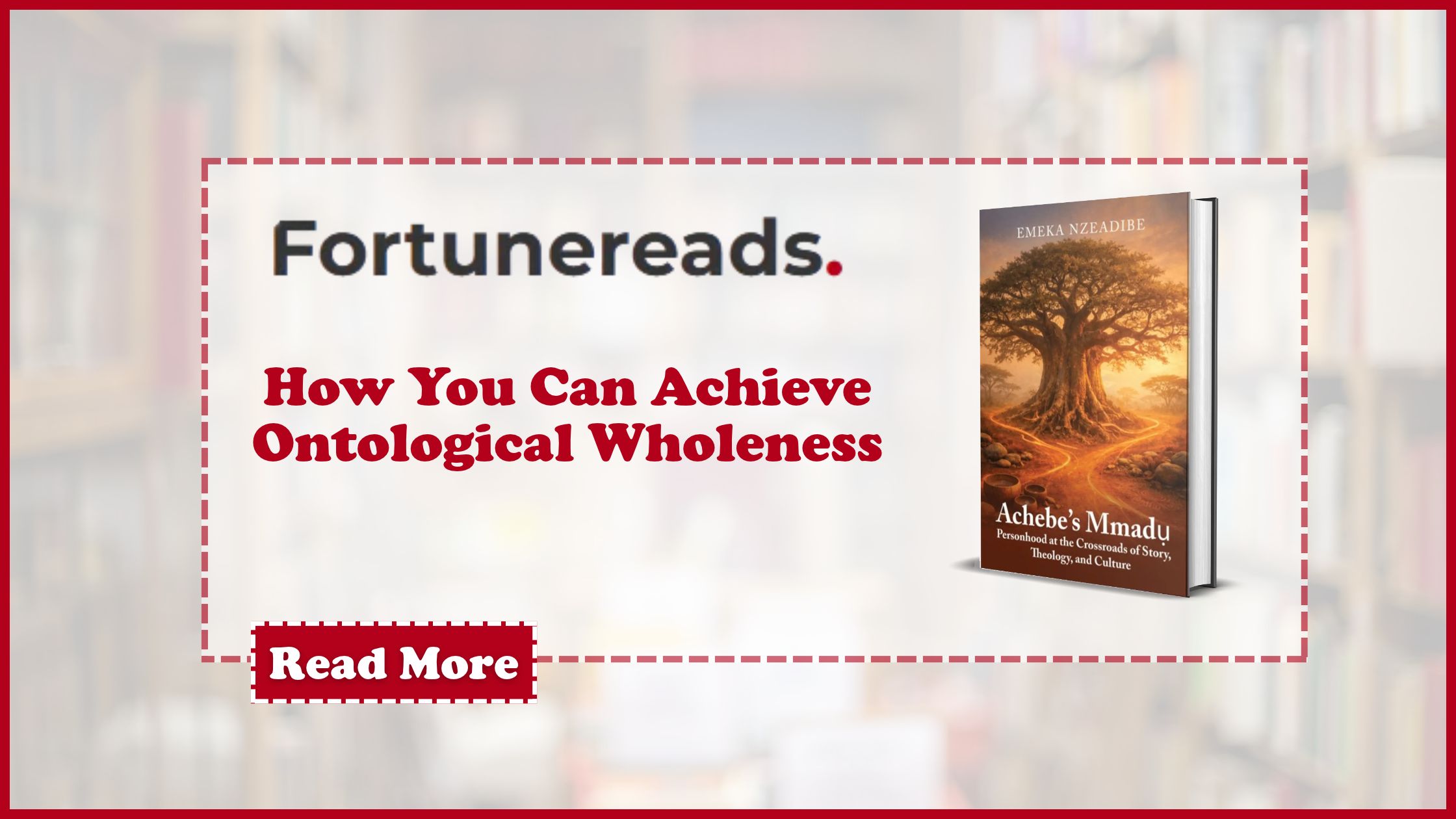
If you were to ask people today what it means to lead a successful life, you can expect them to give credit to career milestones, financial stability, personal happiness, or individual self-actualization. And even if they achieved these external markers of success, millions of people in the modern world still experience a nagging sense of emptiness, alienation, and fragmentation. Why? Why is that so? Why do people feel divided between their public facades and private struggles, isolated from neighbors, and disconnected from any sense of transcendent meaning? To answer this, we can turn to the profound traditional African concept of Ụbandụ. Here, the ontological achievement of personhood and wholeness is deeply articulated in Emeka Nzeadibe’s scholarly monograph. Achebe’s Mmadụ: Personhood at the Crossroads of Story, Theology, and Culture.
Understanding Ụbandụ
In Igbo cosmology, simply being born as a biological human (Homo Sapiens) is only the starting point. True personhood (Mmadụ) is not a static, given state; it is a dynamic, lifelong achievement. It must be cultivated, practiced, and realized through moral integrity, community participation, and spiritual alignment. When an individual successfully navigates this journey, aligning their life with the rhythm of the cosmos and the moral framework of their community, they attain Ụbandụ. They can reach a profound ontological wholeness, salvation, and well-being. Far from being a luxury, achieving Ụbandụ is the ultimate bottom line of human existence. But how does one walk this path in practical terms? How can we cultivate this holistic state of being in our own lives today?
5 Practical Steps Toward Ontological Wholeness
1. Stop Living in Isolation
The first step toward achieving Ụbandụ is shattering the illusion of hyper-individualism. As Nzeadibe emphasizes throughout Achebe’s Mmadụ, human beings are inherently relational creatures. Guided by the Igbo maxim Ife kwụlụ, ife akwụdebe ya (“Where something stands, something else stands beside it”), we must recognize that our lives are deeply intertwined with others. Wholeness cannot be found in self-absorbed isolation. It requires active engagement in supportive communities, repairing broken family ties, and recognizing that your neighbor’s well-being is directly tied to your own.
2. Cultivate Psychological Wholesomeness
In indigenous African thought, a truly whole person is not just intellectually brilliant or materially successful; they possess psychological wholesomeness. This means being emotionally and rationally stable, self-reflective, and able to exercise excellent, balanced judgment. To reach this state, we must step away from impulsive extremes and start practicing introspection, question our unexamined biases, and cultivate the inner peace that comes from emotional maturity and moderation.
3. Align Your Personal Agency (Mmadụ) with Your Inner Purpose (Chi)
A crucial pillar of achieving wholeness is understanding the delicate dance between human effort and spiritual destiny. In Igbo cosmology, every individual is accompanied by Chi—a personal spiritual double and guardian presence. Achieving your potential requires living out the profound wisdom of Onye kwe, chi ya ekwe (“When one says yes, one’s chi says yes”). Wholeness demands proactive effort; you cannot simply sit back and wait for destiny to unfold. You must actively set your goals, work diligently, and make courageous choices while maintaining a harmonious, respectful relationship with your inner spiritual guide.
4. Ground Your Life in Moral Integrity and Community Responsibility
Wholeness is impossible without ethical grounding. In traditional Igbo society, the earth goddess Ani serves as the ultimate guardian of morality and social order. To achieve ontological wholeness, an individual’s actions must uphold justice, truth, and community harmony. When we act with integrity, like Ezeulu in Arrow of God, it comes at a personal cost, but we preserve our community’s sacred trust. Integrity knits the soul together, ensuring our public actions and private conscience are fully aligned.
5. Honor the Power of Story and Narrative Identity
Finally, achieving Ụbandụ requires understanding the stories that shape our lives. As Nzeadibe explores through Paul Ricoeur’s narrative theory in Achebe’s Mmadụ, humans are essentially narrative beings (homo narrans). The stories we tell about ourselves, our families, and our past dictate our future. By engaging with deep, culturally rich literature, myth, and shared histories, we feed our imaginations, heal from past depersonalizations, and construct a meaningful, purpose-driven narrative for our lives.
Achieving ontological wholeness is an ongoing, sacred commitment to living a balanced, relational, and morally grounded life. By stepping away from the isolating traps of modern hyper-individualism and embracing the rich, integrated wisdom of traditions found in works like Achebe’s Mmadụ, we can heal our internal fragmentation, which, through proverbs, myths, and narratives, a culture continues to speak, as Emeka Nzeadibe’s book shows.
Read the book on Amazon: https://a.co/d/0363OG8A
Visit the Author’s Official Website: https://achebesmmadu.com/