Prejudice does not always begin with hatred. Sometimes it begins with an innocent-sounding question, a disapproving glance, or a casual remark about people who belong to a different community. These moments may appear insignificant, especially when they are part of everyday conversation. Yet over time, they can influence how people see their neighbours, whom they trust, and whose suffering they recognise.
The danger is not simply that prejudice exists. It is that people can become so accustomed to it that they stop recognising it.
THE INVISIBLE LESSONS WE LEARN GROWING UP
Our understanding of other people is often shaped long before we develop the confidence to question it.
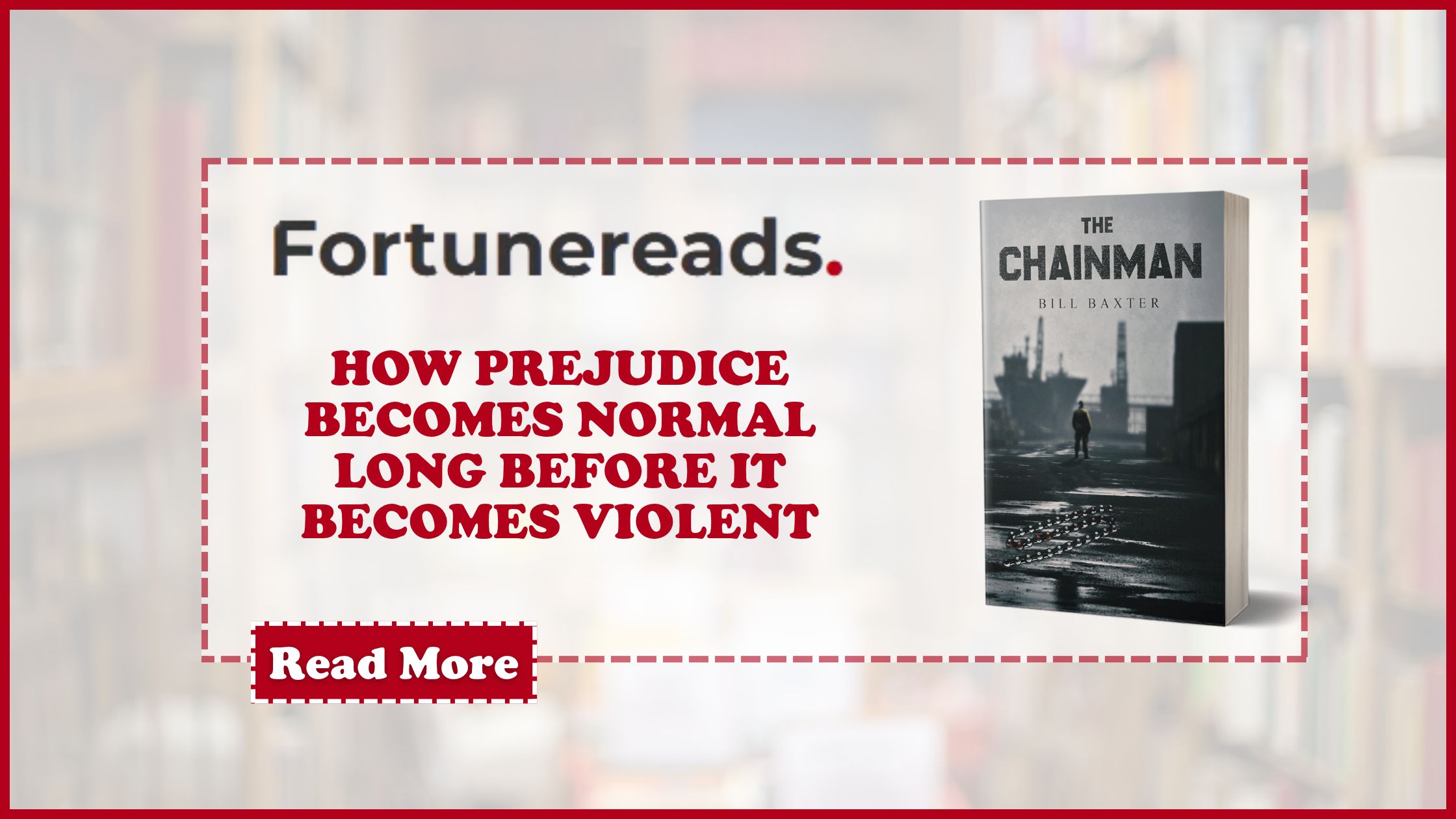
In The Chainman, Billy grows up in Northern Ireland, where religious divisions influence relationships, employment, and social expectations. While working in a Belfast shipyard, he is aware that Catholic apprentices are excluded. Even though he believes religious identity should not matter, he instinctively wonders whether Sarah belongs to the same community as him.
His reaction reveals something uncomfortable about inherited prejudice: people can reject discrimination consciously while continuing to practise its habits unconsciously.
Bill Baxter captures how these divisions are passed through families and communities, not necessarily through direct instructions, but through subtle attitudes, expressions, and assumptions.
A child may learn whom to distrust without anyone explicitly teaching them to hate.
WHEN FAMILIAR ATTITUDES BECOME DANGEROUS
Prejudice becomes particularly harmful when belonging to a group starts to matter more than individual behaviour.
People may overlook cruelty because it comes from someone they consider one of their own. They may accept excuses for aggression that they would immediately condemn if the roles were reversed.
Billy’s complicated friendship with Spam reflects this conflict. Although Billy recognises his friend’s disturbing behaviour, admiration, excitement, and loyalty repeatedly influence his decisions.
Later in The Chainman, Spam becomes involved in loyalist paramilitary activity amid Northern Ireland’s escalating sectarian violence. His growing involvement demonstrates how group allegiance can be used to justify intimidation and harm.
Yet the contradictions are revealing. When Protestant rioters damage his car showroom, Spam discovers that belonging to the same community offers no guarantee of protection.
The supposed security of being on the right side proves dangerously fragile.
RECOGNISING THE HUMANITY BEHIND THE LABELS
One troubling aspect of prejudice is its ability to make people selective in their compassion.
Someone might respond sincerely to an injured stranger while accepting hostility toward an entire community. Personal sympathy and collective resentment can exist within the same individual.
This contradiction matters because violence does not require everyone involved to abandon their conscience completely. Sometimes it is enough to convince people that certain victims belong to a different category.
Bill Baxter presents characters whose actions expose the gap between individual human feeling and the prejudices they have absorbed.
Recognising that gap is an important first step toward challenging it.
BREAKING THE PATTERN BEFORE IT ESCALATES
The most meaningful resistance to prejudice often begins in ordinary situations, long before open conflict.
It means questioning assumptions about someone’s religion, background, or community. It means refusing to excuse harmful behaviour simply because the person responsible belongs to our own group. And it means recognising that inherited attitudes are not obligations we must continue to uphold.
Not every prejudice leads to violence, but allowing suspicion and dehumanisation to become normal makes them easier to defend.
The question is not only whether we would condemn hatred when it becomes violent. It is whether we are willing to challenge it while it still sounds like an ordinary conversation.
AVAILABLE ON AMAZON: https://www.amazon.com/dp/B0FJG9XB1V/