Across industries, intelligent systems are being integrated into daily operations at remarkable speed. Organizations are adopting predictive analytics, automated decision platforms, robotics, and performance monitoring tools to increase efficiency and remain competitive. Deployment timelines are shrinking. Expectations are rising. Yet amid this acceleration, one question demands serious reflection. Is your organization truly measuring AI risk, or simply deploying it?
Implementation alone is not governance. Installing an intelligent system does not automatically ensure it is safe, fair, or aligned with human well-being. Many organizations rigorously test performance metrics such as accuracy, speed, and cost reduction. Far fewer evaluate psychological strain, cognitive overload, autonomy erosion, or the potential for physical harm when humans and machines interact in dynamic environments.
When risk assessment is incomplete, vulnerabilities multiply. Workers may experience heightened stress from constant monitoring. Decision makers may defer too readily to automated outputs, weakening professional judgment. Robotics may introduce mechanical hazards if safeguards are not layered and validated in real world conditions. Vendor supplied systems may contain hidden biases or security weaknesses that become the purchaser’s liability.
Measuring AI risk requires more than technical audits. It demands structured oversight integrated into existing safety and governance frameworks. Organizations must identify where intelligent systems influence health, safety, equity, and operational stability. They must evaluate exposure not only to physical hazards but also to psychosocial and ethical stressors. They must establish measurable indicators, conduct periodic reviews, and retain the authority to pause or remove systems that compromise human welfare.
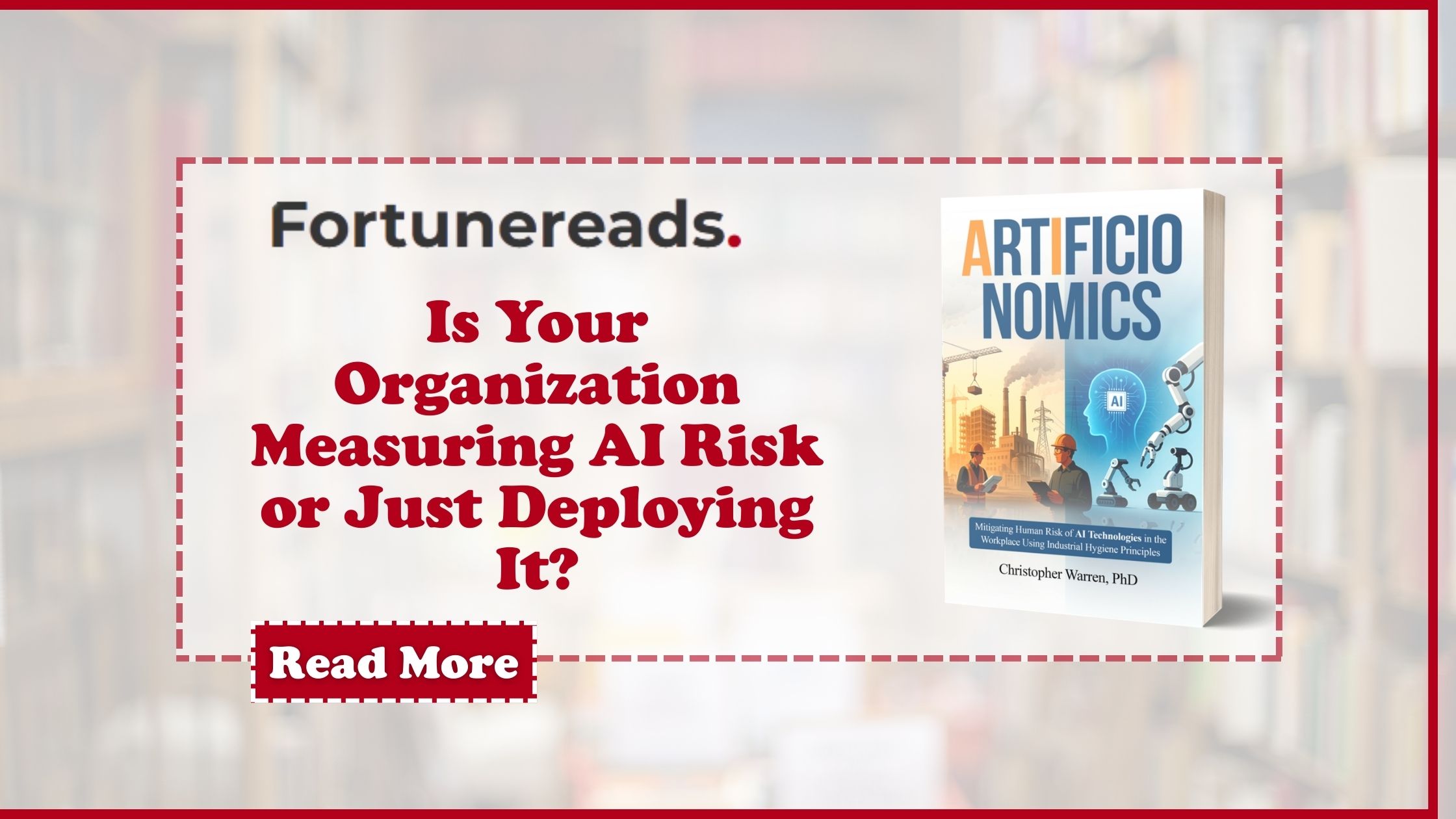
This is precisely the discipline advanced in Artificionomics: Mitigating Human Risk of AI Technologies in the Workplace Using Industrial Hygiene Principles by Dr. Christopher Warren. The book reframes AI related risk as an occupational health issue and extends proven industrial hygiene principles into the digital domain. It provides a structured methodology for anticipating hazards, evaluating impact, and implementing layered controls that protect workers in AI integrated environments.
Artificionomics emphasizes governance from procurement through deployment and monitoring. Contracts must include transparency requirements. Oversight must be measurable. Worker participation must be embedded into design and evaluation. Risk must be treated as a lifecycle responsibility, not a one time compliance exercise.
Organizations that measure risk deliberately build trust. They demonstrate that innovation will not come at the expense of dignity or safety. They create environments where technology enhances capability rather than undermines it. Conversely, organizations that deploy without disciplined measurement may achieve short term efficiency while accumulating long term instability.
The future of work will be shaped not only by what technologies can do, but by how responsibly they are governed. Measuring AI risk is not a barrier to progress. It is the foundation of sustainable progress.
If your organization is investing heavily in intelligent systems, the next strategic question is clear. Are you tracking performance alone, or are you safeguarding people with equal rigor? Artificionomics offers the roadmap to ensure the answer reflects leadership rather than oversight.
Get your Copy Now on Amazon: https://www.amazon.com/dp/B0GFY4RL6B