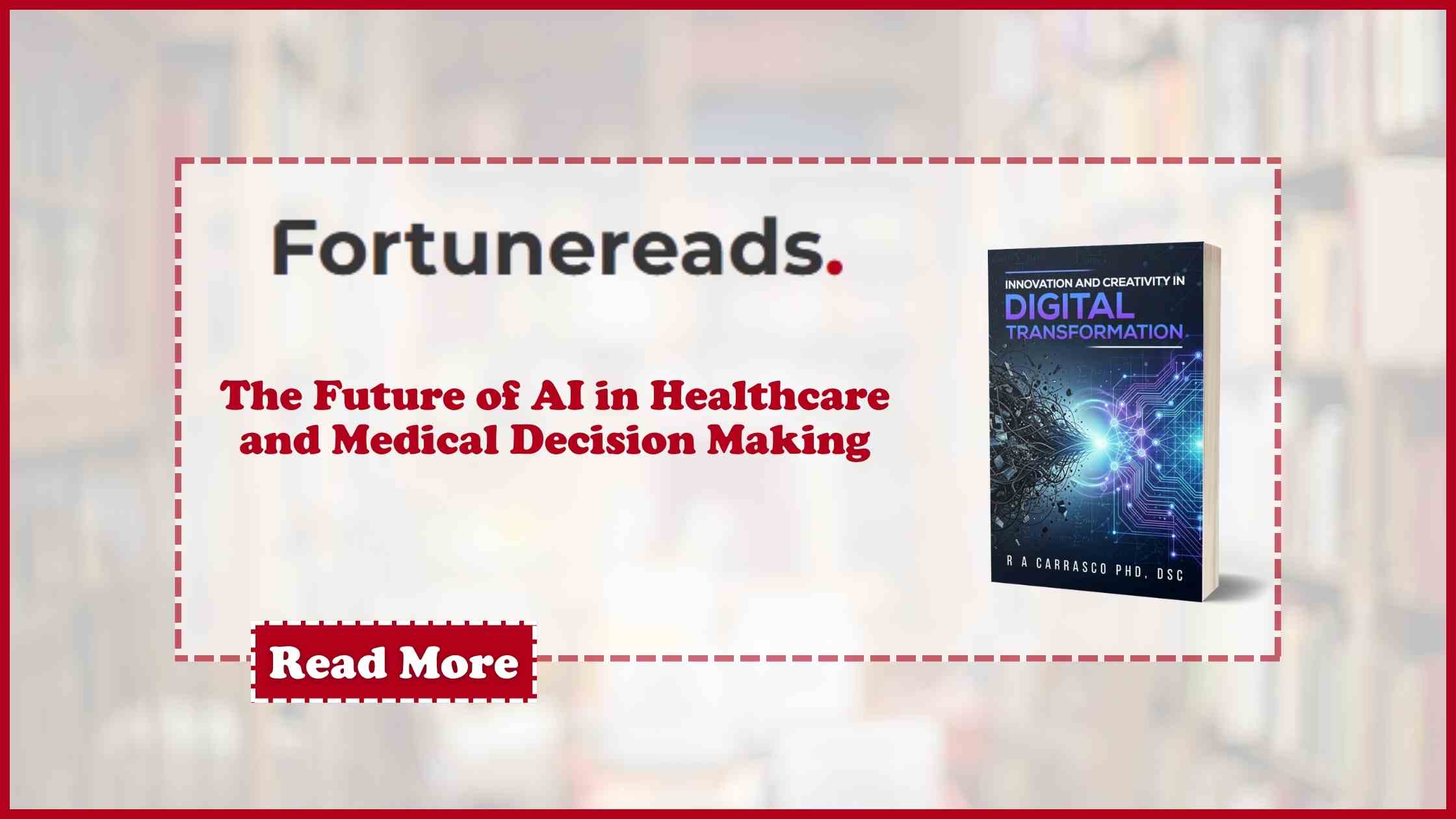
Healthcare is one of the most important areas being changed by artificial intelligence. In Innovation and Creativity in Digital Transformation, R. A. Carrasco explores how digital technology, automation, robotics, machine learning, and data analysis are reshaping medical services. The book presents healthcare as a field where intelligent systems can support better care, faster decisions, and more effective use of medical knowledge.
Modern health services face growing pressure. Ageing populations, rising demand, limited resources, and increasing medical complexity make it difficult for healthcare systems to depend only on traditional methods. Doctors, nurses, researchers, and administrators must manage large amounts of patient information, test results, treatment records, and clinical data. Artificial intelligence can help by organising this information, finding patterns, and supporting decisions that may otherwise take longer to reach.
One of the strongest uses of AI in healthcare is early detection. Machine learning systems can study medical data and identify signs that may suggest disease, risk, or deterioration. This does not remove the role of doctors. Instead, it gives medical professionals another tool to support diagnosis and treatment planning. When used carefully, AI can help clinicians make more informed decisions and respond earlier to patient needs.
Carrasco also discusses the role of robotic applications in medicine. Robotics can assist in surgery, rehabilitation, medical transport, sanitation, prescription dosing, and other important areas. These systems can improve accuracy, reduce physical strain, and support tasks that require consistency. In hospitals, automation can also help manage routine work, allowing healthcare workers to focus more attention on patients and complex decisions.
Medical decision making is becoming increasingly connected to data. AI can support diagnosis, treatment selection, research, training, and health management by analysing information at a scale that humans cannot easily handle alone. In areas such as imaging, symptom analysis, patient monitoring, and predictive care, artificial intelligence can help professionals recognise patterns and compare cases more effectively. This is especially valuable when healthcare systems need to make timely decisions while managing high patient numbers.
However, the book does not present AI as a replacement for human care. Healthcare depends on judgment, compassion, ethics, and responsibility. Machines can process information, but people must decide how that information should be used. Medical decisions affect real lives, so AI must be applied with caution, proper oversight, and clear understanding of its limits.
The future of AI in healthcare will depend on balance. Intelligent systems can make healthcare more efficient, accurate, and responsive, but they must work alongside trained professionals. The best outcomes will come when technology supports human expertise rather than weakening it.
Innovation and Creativity in Digital Transformation offers readers a thoughtful look at this future. Carrasco shows that healthcare transformation is not only about advanced machines or complex algorithms. It is about using knowledge, creativity, and digital tools to improve care, support medical professionals, and help society meet the challenges of a changing world.