For decades, organizations have relied on risk registers to identify, assess and control workplace hazards. From chemical exposures and machinery risks to ergonomic injuries and environmental hazards, risk registers have served as one of the most effective tools in occupational health and safety management.
But today’s workplace is changing.
Artificial Intelligence is rapidly becoming embedded in how organizations operate, make decisions, manage employees and automate complex tasks. While businesses have embraced AI for its ability to improve efficiency and productivity, many have failed to recognize a critical reality:
AI introduces risks that traditional safety programs were never designed to address.
As a result, safety management is entering a new era, one where organizations must begin tracking not only physical hazards but also the human risks associated with intelligent technologies.
This is where AI risk registers become essential.
Most risk registers focus on hazards that can be seen, measured and directly observed. A machine guard is missing. A chemical exposure exceeds acceptable limits. A confined space presents a known danger.
AI-related risks are different.
Many of them are invisible.
They emerge through algorithmic decision-making, workplace surveillance, cognitive overload, automation bias, human-robot interaction, privacy concerns and psychological stress. These risks may not produce immediate incidents, but over time, they can affect worker well-being, organizational trust, productivity and workplace culture.
Consider an organization deploying AI-powered performance monitoring software. The technology may improve efficiency and provide valuable operational data. However, it may also increase employee anxiety, create feelings of constant surveillance and contribute to burnout if workers perceive they are being managed by algorithms rather than people.
Similarly, AI-driven decision support systems can improve accuracy and consistency, yet they may encourage workers to defer to machine recommendations even when human judgment suggests a different course of action.
Without a structured process for identifying and evaluating these exposures, organizations risk overlooking hazards that have significant long-term consequences.
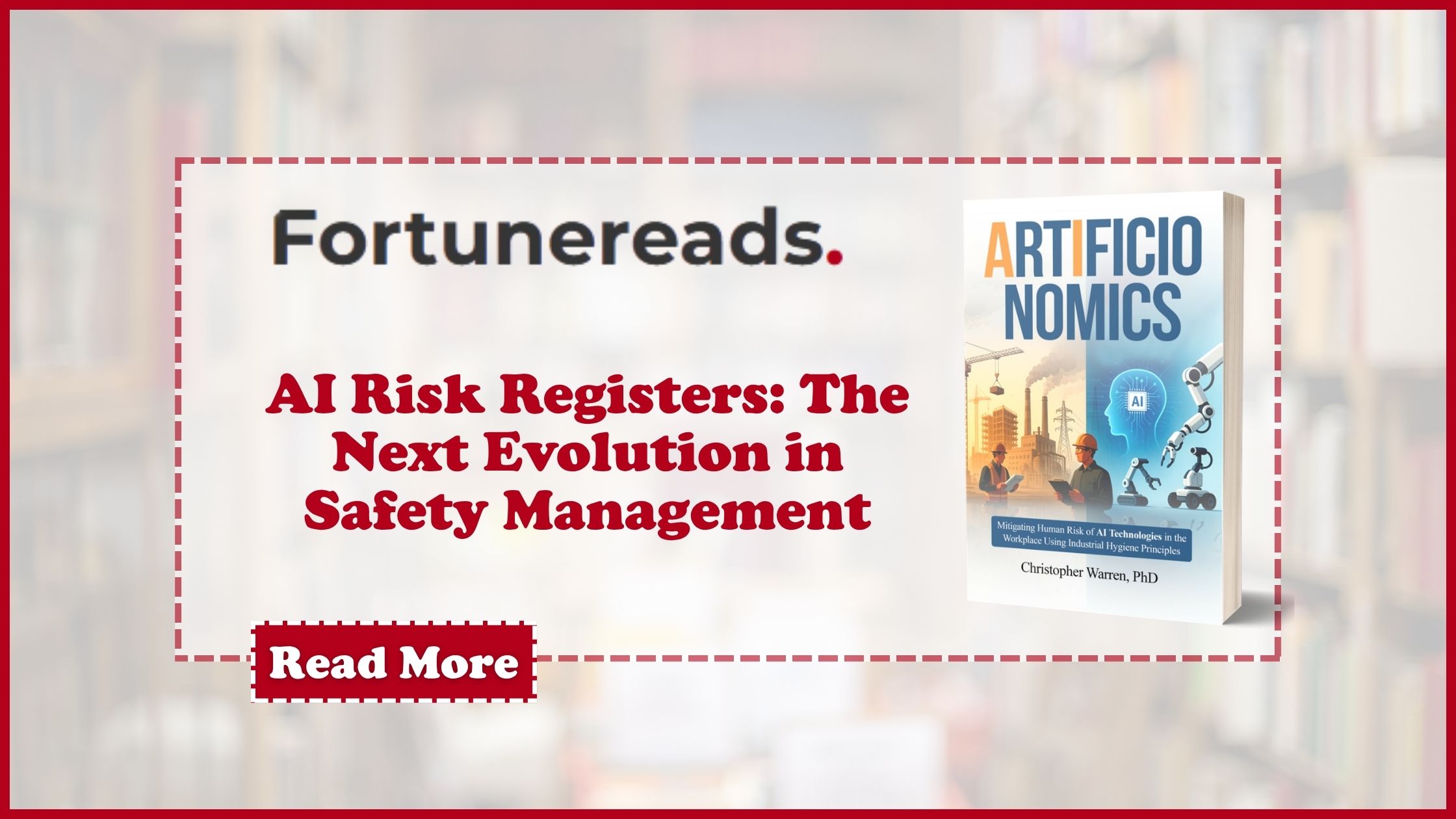
This challenge lies at the heart of ArtificIonomics: Mitigating Human Risk of AI Technologies in the Workplace Using Industrial Hygiene Principles by Christopher Warren, PhD.
The book introduces ArtificIonomics, a groundbreaking framework that applies industrial hygiene principles to the emerging risks created by artificial intelligence and robotics. Just as industrial hygienists identify, evaluate and control traditional workplace hazards, ArtificIonomics expands this process to address the cognitive, psychological, social, ethical and operational impacts of AI.
One of the framework’s most practical concepts is the development of AI risk registers.
An AI risk register provides organizations with a systematic way to identify AI-related hazards, evaluate their potential impact, assign accountability, implement controls and continuously monitor evolving risks. Rather than treating AI as purely a technology issue, it recognizes AI as a workplace exposure that requires the same level of discipline applied to any other occupational hazard.
Forward-thinking organizations are beginning to understand that successful AI adoption depends on more than technical performance. It requires trust, transparency, governance and a commitment to protecting the people who interact with intelligent systems every day.
The future of workplace safety will not be limited to physical environments.
It will extend into digital environments where algorithms influence decisions, robots collaborate with humans and intelligent systems shape the employee experience.
In that future, AI risk registers will become as important as any traditional safety assessment tool.
Organizations that embrace this evolution today will be better prepared for the challenges of tomorrow.
Because managing AI risk is no longer just about protecting technology.
It is about protecting people.
And that is precisely the mission of ArtificIonomics.