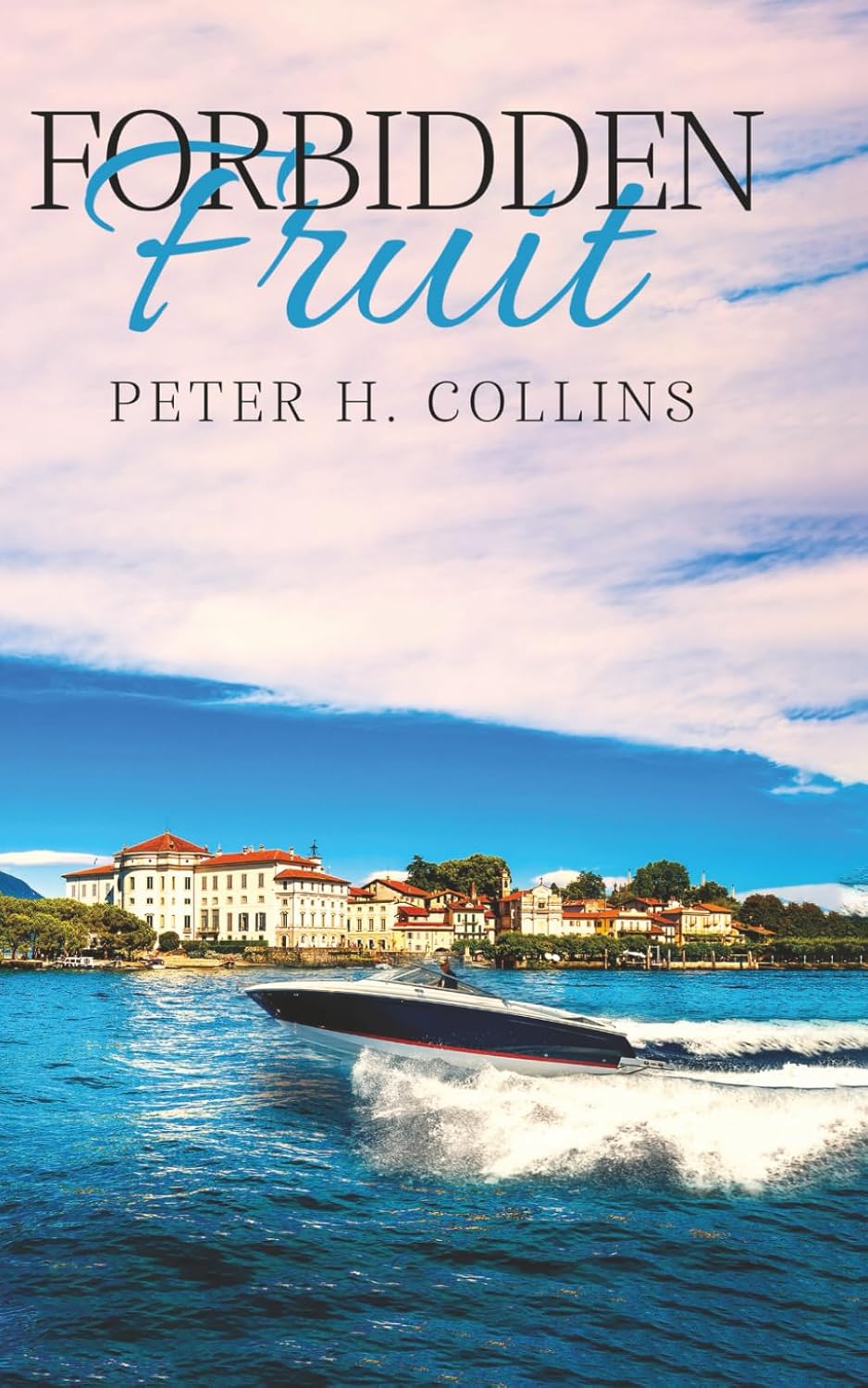
War changes people—not just the ones who carry rifles, but those who carry memories of what was lost in the silence that follows gunfire. In Forbidden Fruit by Peter H. Collins, we are invited into one soldier’s intimate and life-altering journey as he wakes from the clutches of death and finds himself not in the desert battlefield of Baghdad, but in the quiet, healing sanctuary of an Italian hospital.
The novel begins with intensity—an unnamed protagonist caught in the crossfire, wounded by a sniper, and flung into unconsciousness when his vehicle overturns in war-torn Baghdad. That singular moment—a sharp, invisible bullet tearing through flesh—marks the beginning of his spiritual and emotional odyssey. The physical pain is only the beginning. What follows is five weeks of complete darkness, a coma so deep it nearly erased his presence from the living world.
Then, as the reader turns the page, a light appears—not just metaphorically, but literally, in the form of a woman who could only be described as an angel.
“She was a cross between Elizabeth Taylor and Jean Simmons,” he reflects—a deeply cinematic comparison that reveals not only the narrator’s appreciation for beauty but also the stark contrast between the horror he has seen and the peace this woman seems to radiate.
Her arrival is not dramatic, but it shakes the foundation of his reality. Dressed in a blue nurse’s uniform cinched neatly at the waist, she is not just a caregiver. She is his first connection back to life. The hospital, St. Paulo just outside of Milano, becomes the stage where the war-torn body begins to mend, but more importantly, where the fractured soul begins to feel again.
Peter H. Collins doesn’t simply describe a medical recovery; he crafts a spiritual reawakening. Waking from the coma is not like opening one’s eyes after sleep—it is a confused, dreamlike gasp for understanding. “Where am I? What’s happened? How long have I been here?” he demands. These questions aren’t just about place and time; they’re about purpose, identity, and survival.
The woman—his angel, the nurse—becomes a symbol of healing. Her voice, her compassion, her very presence is what pulls him out of the fog. Collins writes her with reverence, not just as a love interest or an archetype of beauty, but as the personification of hope. She brings grace into his battlefield, tenderness into his trauma.
Forbidden Fruit is more than a war story; it is a story about what lies beyond the battlefield. It asks, what happens after the bullet? After the pain? After the mind wakes and finds the world still turning without it? It’s in this space that Collins excels—delivering not just emotional catharsis, but quiet revelations.
The juxtaposition of a war-ravaged soldier in a soft-lit hospital room in Italy creates an emotionally powerful setting. Through the protagonist’s eyes, we see not only his physical injuries but also his yearning for purpose, his unexpected vulnerability, and his hesitant curiosity about the woman who now stands beside him like a guardian of second chances.
If you’re looking for a novel that blends war, romance, emotional complexity, and poetic redemption, Forbidden Fruit is that rare literary harvest. It reminds us that sometimes the sweetest fruits grow in the most forbidden places—and that love, even when born in hospital corridors and shaped by battlefield scars, can be the most unexpected miracle of all.