People often imagine verses about love, nature, or fleeting beauty when they think of poetry. Yet poetry has always been more than that. It is a vessel for memory, capturing personal and collective histories. In the years after the fall of communism in Eastern Europe, a new wave of writers and poets emerged, carrying with them stories shaped by hardship, resilience, and transformation. These voices did not just describe their inner lives. They echoed the landscapes of their countries, the streets, the silence, and the struggles that remained long after the system had collapsed.

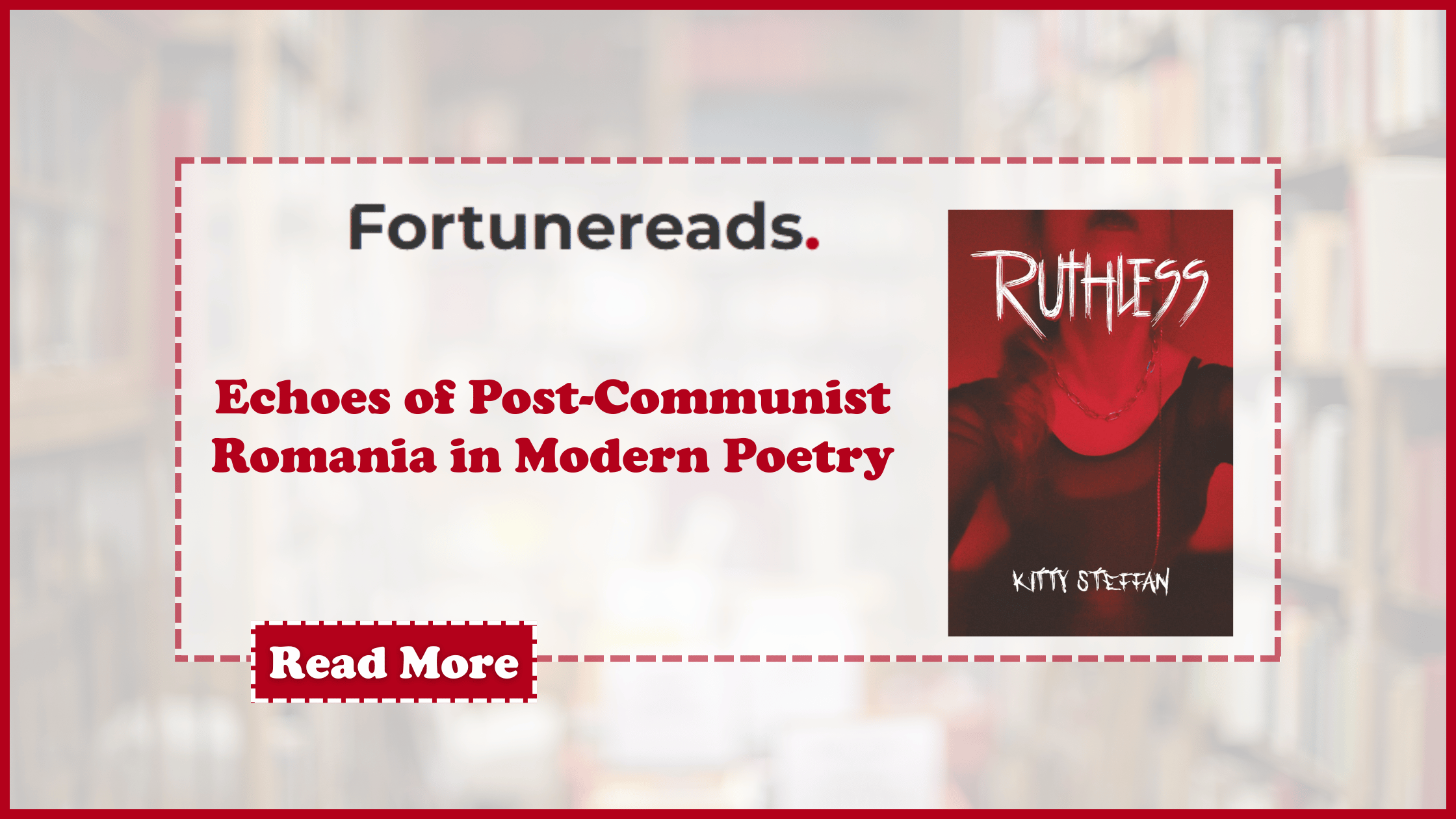
Kitty Steffan’s Ruthless is a rare modern collection that breathes life into this legacy. Born and raised in Rădăuți, a northern Romanian town close to the border, Steffan grew up in a place marked by transition. The post-communist years were full of contrasts: freedom came, but so did uncertainty; tradition persisted, yet new influences pressed in from the West. These tensions are woven into her poems, where loss and resilience walk side by side.
Her family history deepens this texture. She comes from a long line of fiery women and sensitive men, and their presence runs through the collection like an invisible thread. In her acknowledgments, she names grandmothers, great-grandmothers, and even great-aunts who shaped her understanding of strength, survival, and sacrifice. Their stories, whether fleeing during war, reading tarot cards in small towns, or simply giving what little they had, form the backbone of a family that survives in her art. That is why her poetry feels not just personal; it feels generational.
Take the poem “Groundmother,” for example. Death becomes a frightening and tender grandmother figure, curling up at the end of a fork or waiting at a window. It is a striking image that reveals how memory and myth blur in the poet’s imagination. This kind of metaphor feels instantly recognizable for anyone who grew up in post-communist Romania, where family elders often carried the trauma and wisdom of the past. The rawness of her words is not just literary style. It is a lived truth.
Modern poetry thrives on honesty, and Steffan’s honesty is rooted in a Romanian context that gives her work its edge. The post-communist backdrop and her later life in Sweden create a dual perspective. She writes both as someone formed by Romania’s grit and as someone looking back from abroad. This balance allows her to capture a sense of belonging and displacement at once, a voice that speaks to anyone who has ever left home but still carries its shadows within them.
In many ways, Ruthless reminds us why poetry still matters. It does not just entertain; it preserves memory and translates it into art others can feel. Her work’s echoes of post-communist Romania are not locked in the past. They live on in every stanza, every sharp line, every tender confession.
Kitty Steffan’s Ruthless is a fearless debut worth reading for readers who want to experience this blend of history, identity, and raw lyricism.