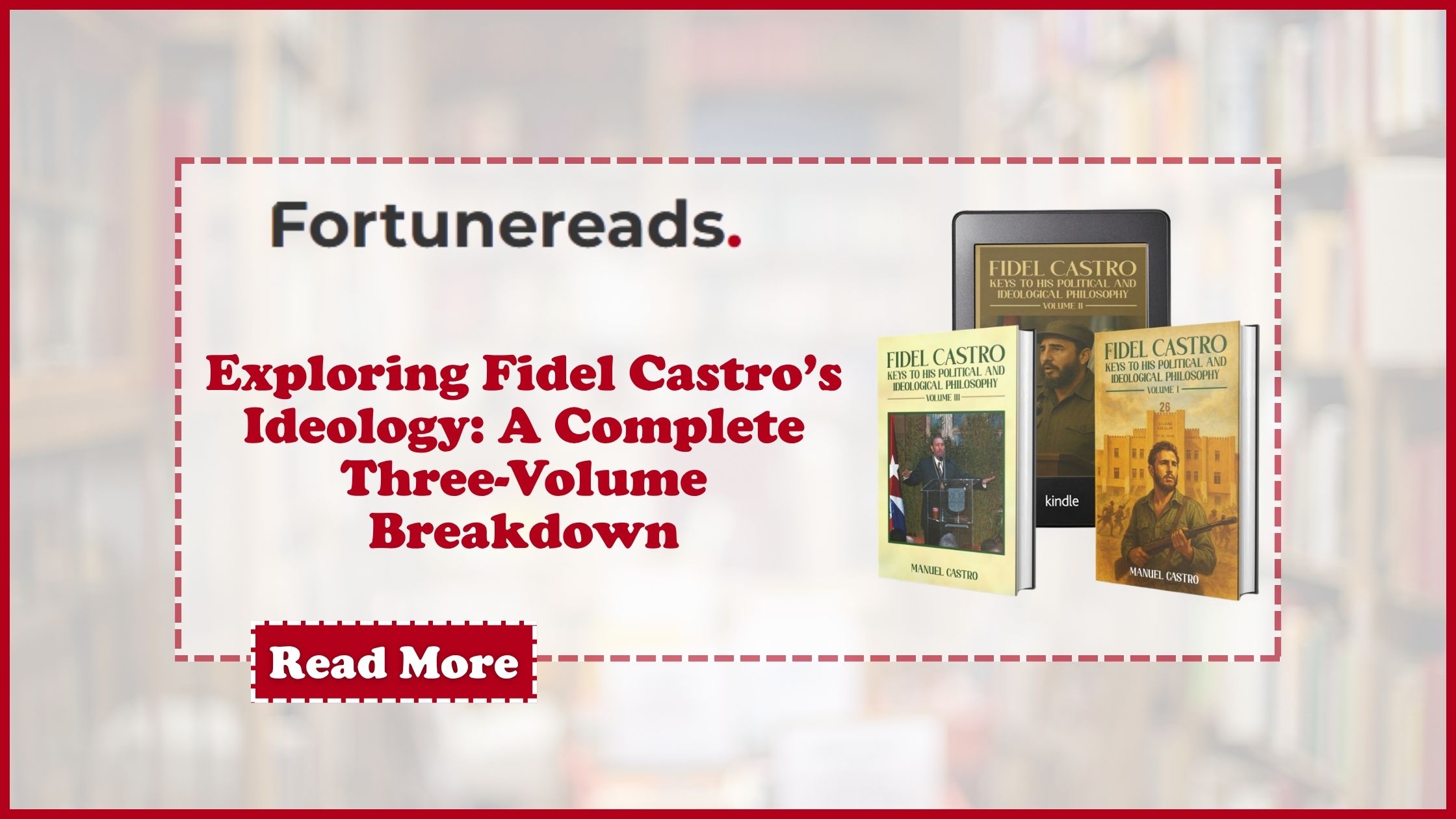
Understanding a figure as complex and polarizing as Fidel Castro requires more than a quick glance at history. It demands a deep dive into the ideas that shaped his leadership, decisions and long-lasting global influence. That’s exactly what Fidel Castro: Keys to His Political and Ideological Philosophy (Volumes I–III) by Manuel A. Castro delivers: a comprehensive, thought-provoking exploration of one of the most debated ideological frameworks of the modern era.
This three-volume series is not just a collection of political observations; it is a carefully structured intellectual journey. Rather than presenting a linear narrative, the books break down Castro’s ideology into a wide range of interconnected concepts, which the author describes as a “philosophy of variables.” These variables span topics such as revolution, sovereignty, social justice, education, media influence, economic systems and international relations. Each concept is explored in depth, allowing readers to understand not only what Castro believed but how those beliefs functioned together as a unified system.
Volume I lays the groundwork by introducing the foundational elements of Castro’s thinking. It explores how revolutionary ideology is formed and how it connects to broader social and political transformation. Here, readers begin to see the emphasis on collective action, national identity and the moral dimensions of leadership. It is a starting point that builds a strong conceptual base, preparing readers for the more complex discussions that follow.
Volume II takes a deeper dive into the mechanisms of power and global dynamics. It focuses heavily on themes such as capitalism, imperialism, resistance and the role of organized society. This volume is particularly compelling for those interested in understanding how Castro’s ideas positioned Cuba within a global context. It highlights the tension between dominant global systems and emerging alternatives, offering insights that remain relevant in today’s geopolitical landscape.
Volume III expands the conversation further by connecting ideology with historical evolution and long-term impact. It examines key events, influential figures and the continuity of revolutionary thought over time. More importantly, it reflects on the legacy of Castro’s philosophy, analyzing its strengths, challenges and enduring significance. This final volume brings everything together, allowing readers to see the full scope of an ideology that has shaped not only a nation but also international discourse.
One of the most powerful aspects of this trilogy is its focus on the role of ideas as instruments of change. Castro understood that revolutions are not sustained by force alone; they are sustained by belief. His speeches and writings were designed to educate, mobilize and inspire, turning ideology into action. The books capture this dynamic with clarity, showing how communication can be used to build unity, influence perception and drive collective effort.
Another key strength of the series is its global relevance. While rooted in the Cuban experience, the ideas explored in these volumes extend far beyond national borders. Issues such as inequality, sovereignty, development and cultural identity are universal and the trilogy provides a framework for understanding them in a broader context. It encourages readers to think critically about the systems that shape our world and the possibilities for change within them.
What sets this work apart is its balance. It doesn’t aim to simplify or reduce Castro’s ideology into easy conclusions. Instead, it presents the complexity in a way that is both accessible and intellectually engaging. Whether readers approach the subject with curiosity, skepticism or admiration, the trilogy offers valuable insights that go beyond surface-level interpretations.
Fidel Castro: Keys to His Political and Ideological Philosophy (Volumes I–III) is more than a study of one leader; it is an exploration of how ideas can shape history, influence societies and spark global conversations. For anyone seeking a deeper understanding of political thought and its real-world impact, this complete three-volume breakdown is an essential read.