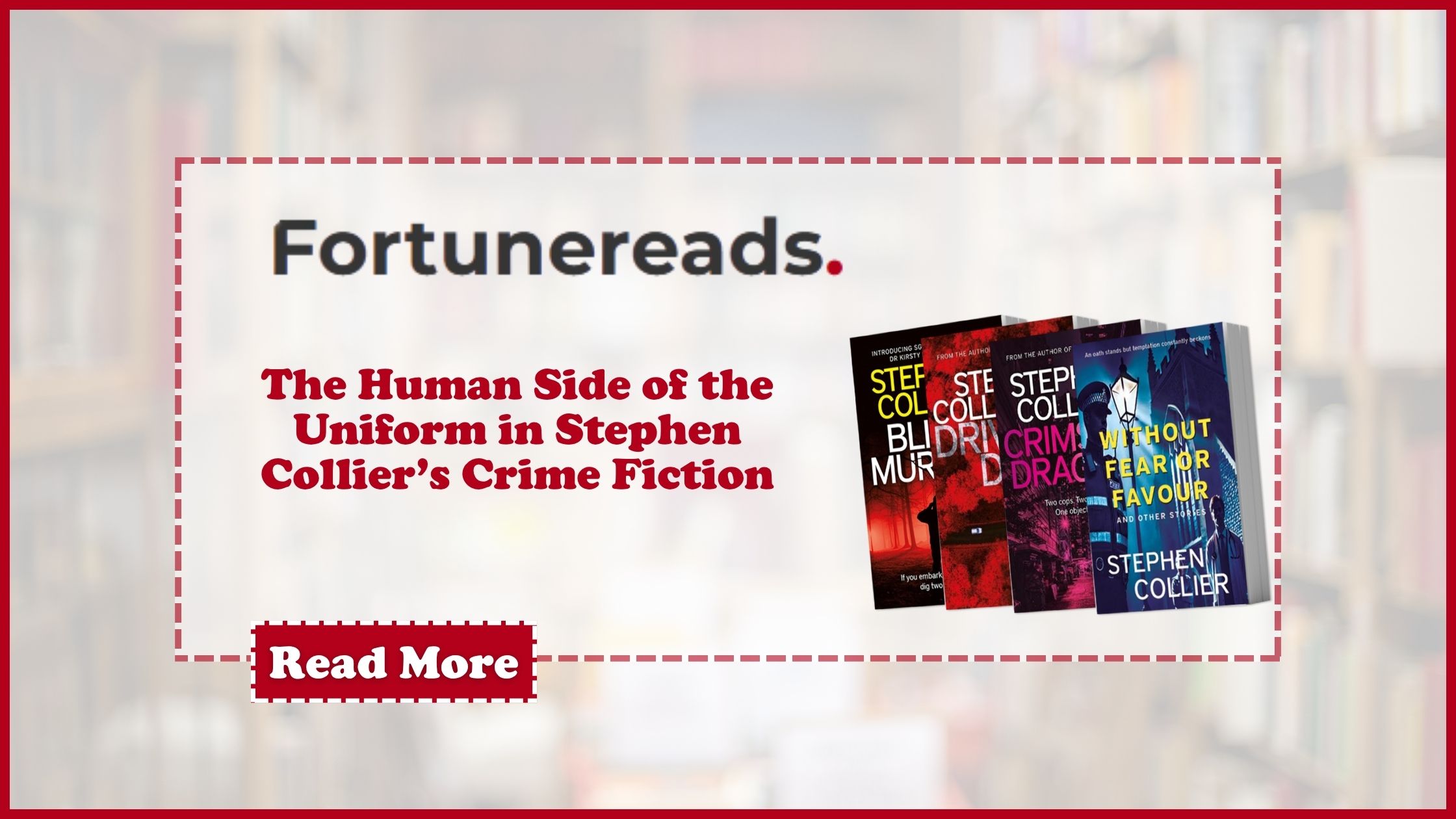
A police uniform can suggest authority, control and resilience. Crime fiction often reinforces that image, presenting officers as people who move from one disturbing scene to the next without carrying much of it home. Stephen Collier’s fiction takes a more human approach.
Across Blind Murder, Driving Dead, Crimson Dragon and Without Fear or Favour and Other Stories, police officers are not simply there to arrest suspects and explain procedures. They are people affected by what they witness, shaped by past experiences and forced to make difficult decisions under pressure.
That is especially clear in Blind Murder. Jake Jordan and Jim Kingsfield arrive at a Northampton address with eighteen-year-old police cadet Stephanie Parker, expecting what appears to be another routine incident. The quiet street and open front door immediately create unease and the situation quickly becomes much more serious.
When Parker encounters a murdered woman for the first time, the story gives real attention to her shock. Jordan understands that the image may remain with her for the rest of her life, while he also recognises that officers sometimes have to find a way to mentally “park” experiences that cannot simply be forgotten. That moment captures one of Collier’s recurring themes: professionalism does not make someone immune to trauma.
Driving Dead continues that exploration through Jake Jordan, who is already carrying emotional and professional damage from previous events. Early in the novel, he wakes from recurring nightmares about his exploding police car and reflects on deaths, disciplinary consequences and the breakdown of his marriage.
The road-policing setting also puts officers face-to-face with sudden death in a different way. They deal with devastated vehicles, injured families and scenes where ordinary journeys have ended catastrophically. As the investigation develops, the case becomes even darker, revealing revenge driven by grief and obsession.
In Crimson Dragon, the emotional pressure becomes international. The novel opens with specialist firearms officers entering a dangerous operation in London’s Chinatown. They rely on training, equipment and one another, but the raid quickly turns violent and brings immediate professional consequences.
Later, Alex Shipley becomes increasingly convinced that the officers involved are being hunted. He feels watched, becomes paranoid and struggles with what is described as PTSD after colleagues are killed or seriously injured. The uniform may represent authority, but it offers no protection against fear.
Detective Inspector Mandy Lee adds another perspective. She has fought to establish herself within the Hong Kong murder squad while also carrying family tensions and difficult childhood memories. Her determination to prove herself sits alongside insecurity and personal conflict.
Without Fear or Favour and Other Stories broadens these ideas further. Its four crime stories and two paranormal tales explore policing alongside loyalty, political pressure, faith, revenge and moral responsibility.
Across Stephen Collier’s work, the badge never completely hides the person wearing it.
His officers can be frightened, angry, exhausted, loyal, damaged, funny and compassionate. They do their jobs, but the job also changes them.
For readers who want crime fiction that looks beyond procedure and sees the people inside the uniform, Stephen Collier’s books offer a compelling and often deeply human perspective.
The book can be purchased from Amazon: https://www.amazon.com/stores/author/B00L4JZ7P4/allbooks