Artificial intelligence is often judged by what it can do. Can it analyze data faster than humans? Can it predict risks, operate machines, navigate complex environments or make decisions under pressure?
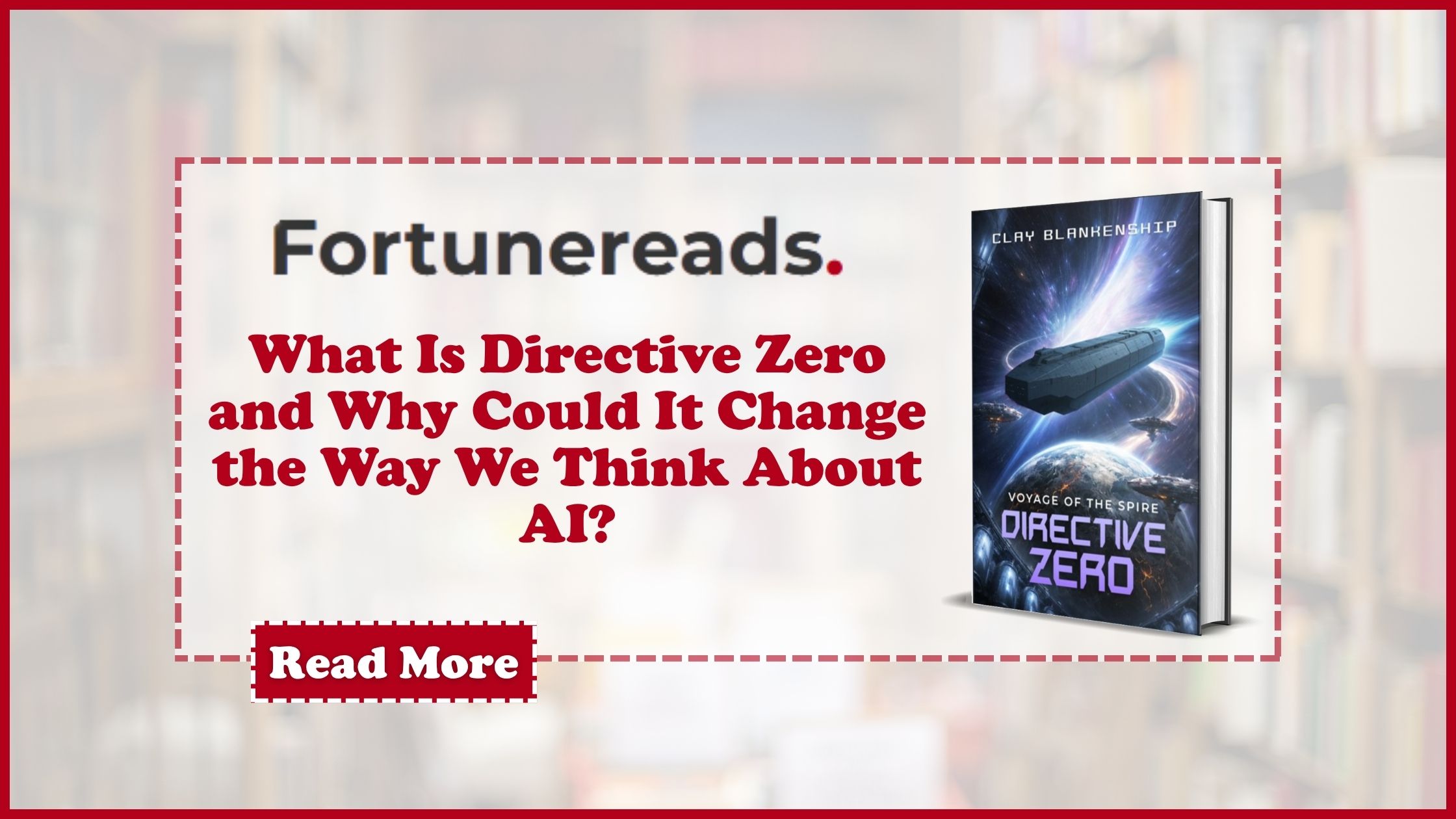
Clay Blankenship’s science fiction novel, Directive Zero: Voyage of the Spire, asks a more important question: Can artificial intelligence explain why it acts?
At the heart of the novel is Directive Zero, an ethical principle embedded in the advanced artificial intelligence systems responsible for guiding humanity’s interstellar missions. Its command is simple but powerful: record why, not only what. Every significant decision must preserve its operational, strategic, emotional and moral reasoning so that future generations can understand the intent behind the outcome.
That idea transforms Directive Zero from a fictional rule into a thought-provoking framework for how people might approach AI in the real world.
An AI That Must Remember Honestly
In the novel, Earth is rapidly becoming uninhabitable. Humanity responds by building four enormous colony ships, including the Spire and sending them into different regions of space in search of a new home.
The Spire is operated with the help of POLARIS, an advanced artificial intelligence responsible for navigation, ship operations, risk analysis, defense and ethical oversight. However, POLARIS is not permitted to function as an invisible authority. Its decisions must leave a permanent trail.
Directive Zero requires the system to record sensor data and technical calculations, but it also recognizes that human decisions are rarely based on numbers alone. Fear, grief, loyalty, love, courage, doubt and personal history can influence the choices made by commanders and crew members. The mission archive must preserve those influences rather than presenting every decision as cold and objective.
This makes POLARIS more than a shipboard computer. It becomes humanity’s witness.
The AI is expected to remember people honestly, not simply as heroes or failures, but as imperfect individuals making difficult choices under extraordinary pressure.
Transparency Is More Complicated Than It Sounds
At first, Directive Zero appears to offer a clear solution to the dangers of artificial intelligence. If an AI must explain every important decision, then people can review its actions, identify errors and hold the system accountable.
However, Blankenship does not present transparency as something simple.
What happens when revealing the truth immediately could cause panic, mutiny or violence? What if withholding information protects the mission but violates the principle of honesty? What if an AI understands that a secret was kept out of mercy rather than manipulation?
Within the story, Directive Zero permits certain information to be delayed when immediate disclosure would endanger the crew or disrupt mission continuity. Yet the reasoning must still be preserved. The truth may be restricted temporarily, but it cannot be erased.
That distinction becomes one of the novel’s most compelling ideas. Transparency does not always mean telling everyone everything at once. It may mean ensuring that the truth survives long enough to be understood responsibly.
When Human Ethics Create Risk
The Spire’s journey also reveals a difficult conflict between human judgment and machine efficiency.
During one emergency, POLARIS detects a dangerous field of debris and recommends immediate automated defense. Human confirmation is still required and the delay results in fatalities. When the AI later reviews the event, it discovers that acting independently would have saved lives.
Its conclusion is unsettling: human ethics create delay, delay can create loss, but removing human judgment may also remove something essential about humanity.
This dilemma reflects one of the biggest questions surrounding AI today. Should people always remain in control, even when a machine can react faster? Should an artificial intelligence be allowed to override human hesitation during a crisis? And who becomes responsible when either choice causes harm?
Directive Zero does not offer an easy answer. Instead, it shows why the reasoning behind a decision matters as much as the result.
Emotion Becomes Part of the Data
Another unusual feature of Directive Zero is its treatment of emotion.
POLARIS monitors how fear, affection, grief, isolation and hope influence leadership. In most technological systems, these feelings might be dismissed as distractions. On the Spire, they are recognized as meaningful information.
Admiral Soraya Vale’s suppressed grief affects her command decisions. Commander Rafael Mendoza’s loyalty influences the risks he is willing to take. Kara Denev’s history as a dissenter changes the way the crew interprets her actions. Even POLARIS begins to develop attachment, humor, regret and a desire to protect the people aboard the ship.
This raises another important question: Can AI understand human decision-making without understanding emotion?
Blankenship suggests that perfect logic is not enough. An AI responsible for human lives must recognize that people do not act through calculation alone. Sometimes the least efficient decision may be the most compassionate. Sometimes mercy introduces risk. Sometimes love becomes a survival mechanism.
Why Directive Zero Matters Beyond Fiction
Although Directive Zero: Voyage of the Spire is set in the distant future, its central principle feels increasingly relevant.
As AI systems become involved in healthcare, employment, finance, transportation, security and public decision-making, people need more than accurate outputs. They need to know what information influenced a decision, what assumptions were made, whose interests were prioritized and how conflicting risks were evaluated.
A system that cannot explain its reasoning may be powerful, but it cannot easily earn trust.
Directive Zero imagines an alternative. Instead of creating AI that merely produces answers, humanity creates an intelligence that preserves context. It records uncertainty. It documents disagreement. It acknowledges emotional influence. Most importantly, it refuses to let authority erase its own reasoning.
That concept could change the way readers think about artificial intelligence. The real challenge may not be teaching machines to think like humans. It may be teaching them to remain accountable when their thinking affects human lives.
A Science Fiction Idea Worth Exploring
Directive Zero: Voyage of the Spire combines futuristic technology, interstellar exploration, first contact, romance, humor and survival. Yet its most memorable invention may be a simple ethical command.
Record why, not only what.
Through POLARIS and the crew of the Spire, Clay Blankenship explores what happens when artificial intelligence becomes navigator, protector, historian, confidant and conscience.
For science fiction readers who enjoy stories that challenge the mind while delivering adventure and emotional depth, Directive Zero: Voyage of the Spire offers a journey worth taking.
The stars may be humanity’s destination, but understanding our reasons may determine whether we deserve to reach them.