Marriage in the nineteenth century could shape nearly every part of a woman’s life.
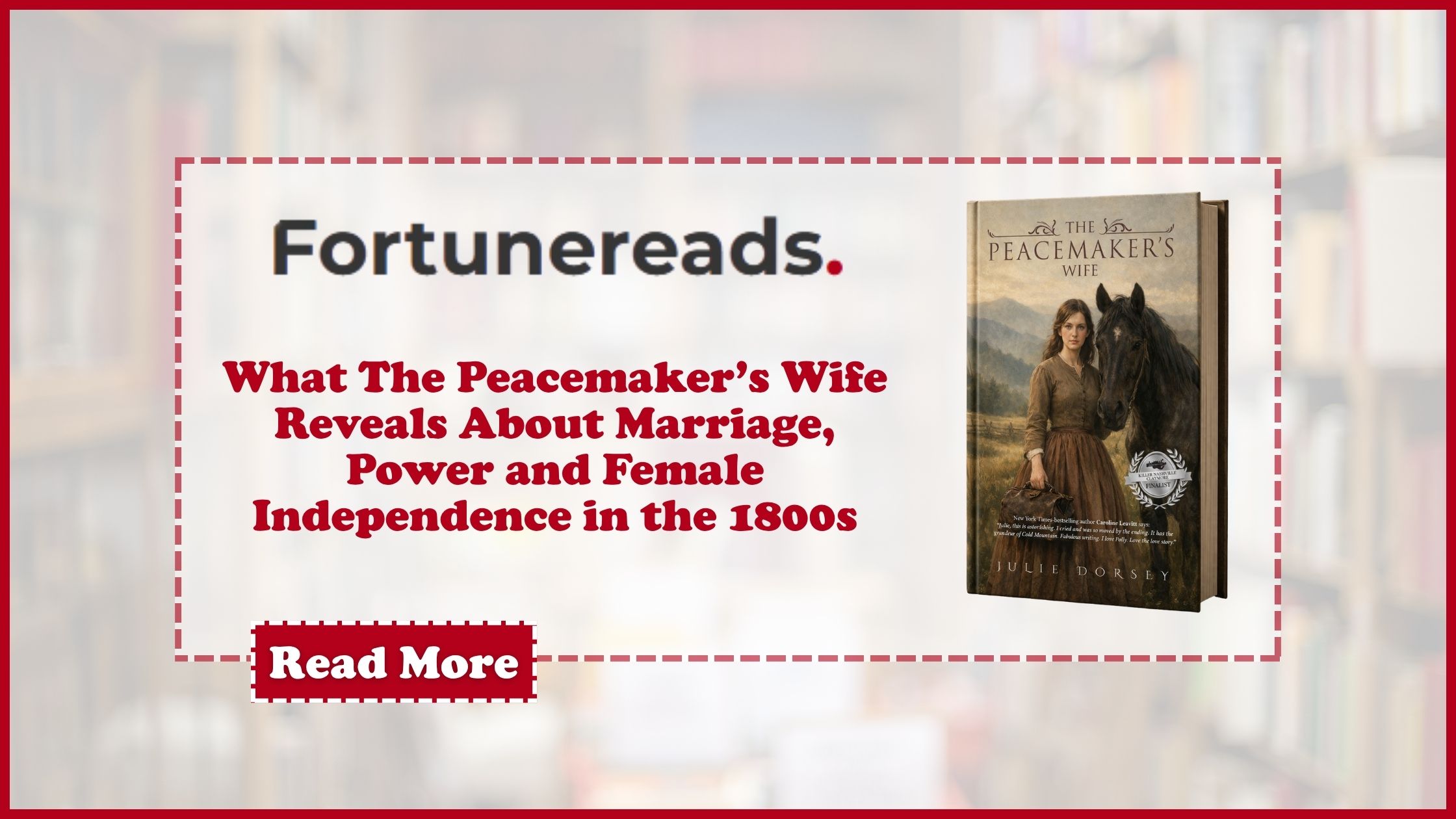
Her home, her reputation, her finances, her children and even the kind of work she was expected to do were often tied closely to her husband. In Julie Dorsey’s The Peacemaker’s Wife, those pressures become deeply personal through the story of Polly Justice.
Polly is married to John Justice, a respected man in the Blue Ridge Mountains of North Carolina. His ability to settle disputes earns him the nickname “The Peacemaker,” and his standing in the community gives him influence.
But Polly’s life reveals the complicated reality behind that public image.
John expects her to be a wife and mother first. He has ambitions of his own and those ambitions are treated as natural. Polly’s desire to build a calling outside the home is not always given the same respect.
She wants to heal people.
After the death of her baby sister Lucindy, Polly becomes determined to learn more about childbirth and medicine. She studies, improves her reading and writing, learns traditional remedies from Nan Clark and gradually begins treating people across Blue Ridge.
Eventually, neighbors come to depend on her.
Polly becomes Doctor Polly.
That transformation matters because it gives her something that belongs to her alone: an identity not defined by marriage.
Her work also creates tension at home.
John’s jealousy, drinking, anger and violence expose an important question about power. The same man trusted to resolve conflict in public often tries to control Polly in private. He wants to decide how much freedom she should have, where her responsibilities begin and end and what kind of woman she should be.
Polly resists.
She continues treating patients. She delivers babies. She keeps learning. She refuses to accept that being a wife means giving up the work she believes God has called her to do.
Her emotional life complicates matters further.
Polly never fully stops loving Sam Edney, the man she cared for before marrying John. Yet leaving her husband is not a simple romantic decision. She has children to consider. She has a reputation to protect. She knows that the community’s judgment could threaten her ability to continue practicing as a healer.
That makes Polly’s choices feel larger than a love triangle.
She is trying to find a way to belong to herself.
The Civil War, murder, loss and violence all increase the stakes as the novel progresses, but Polly’s fight for independence remains central. Her freedom is not about abandoning responsibility. In many ways, the opposite is true.
She wants the right to choose which responsibilities define her.
That is what gives The Peacemaker’s Wife its relevance beyond its historical setting.
Julie Dorsey presents marriage not simply as romance, but as a structure that can involve love, obligation, dependency, power and conflict all at once. Polly’s journey shows how difficult it could be for a woman to claim authority over her own life when social expectations were working against her.
For readers who enjoy historical fiction with strong female characters, complicated marriages, moral conflict, romance and social themes, The Peacemaker’s Wife offers more than a compelling story.
It offers a portrait of a woman learning that independence begins when she refuses to let someone else define who she is allowed to become.