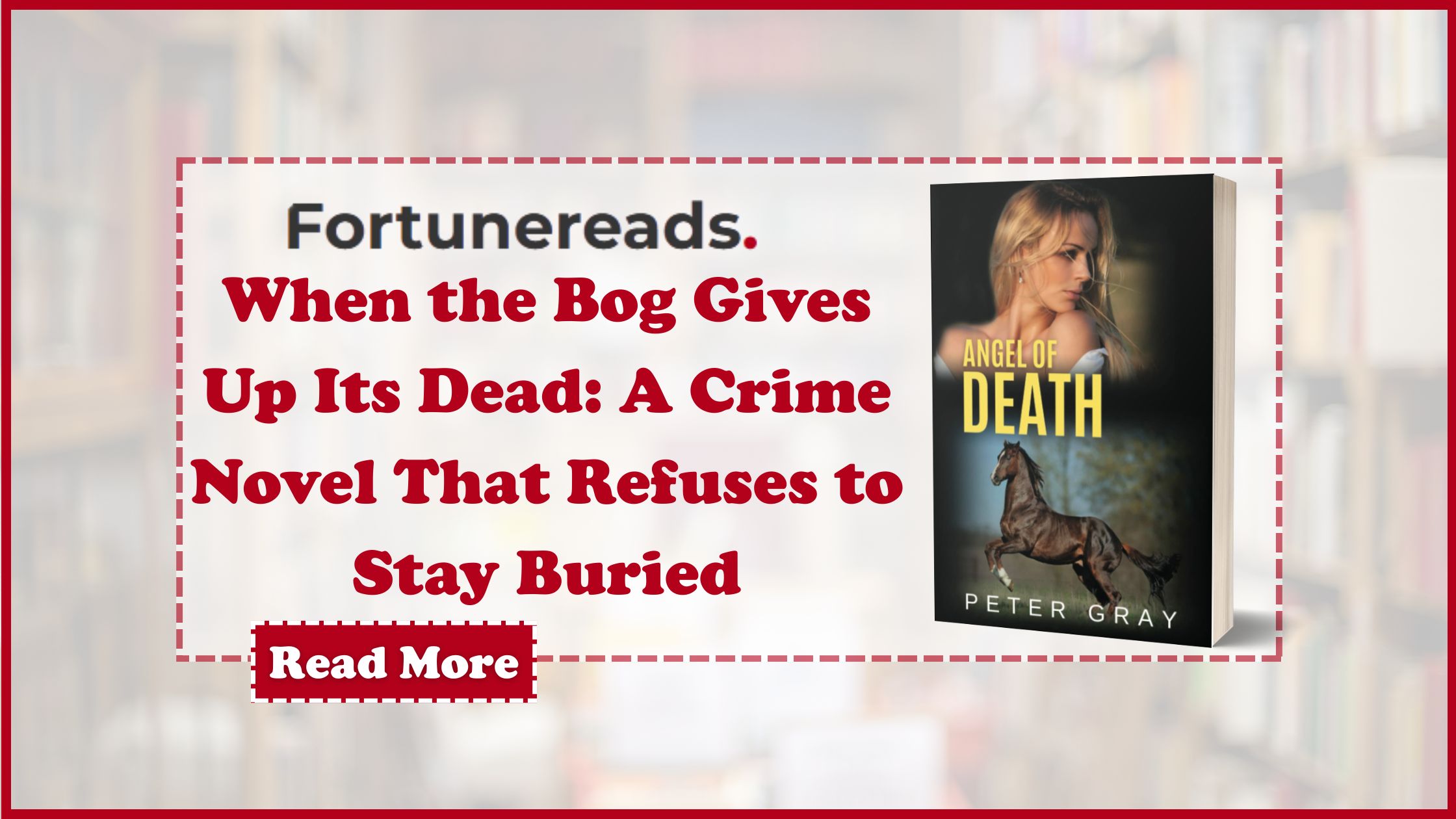
What if the ground beneath you hides a dark secret? There is something deeply unsettling about the idea that the land itself can keep secrets. For centuries, Irish bogs have preserved history in silence, holding onto what the living chose to forget. Angel of Death by Peter Gray begins with exactly that kind of silence being broken.
When the Caffrey family are cutting turf on a Kerry bog, and their sheepdog produces a human bone, the discovery feels both shocking and inevitable. This is not a dramatic opening meant to thrill for its own sake. It is quiet, rural, and disturbing in its ordinariness. From this moment, the novel establishes its core strength. Crime does not explode into life. It seeps upward.
Garda Detective Inspector Trey O’Driscoll is assigned to investigate the find. From the outset, he senses that this is no accidental death and no historical relic. Gray allows the investigation to unfold methodically, respecting the slow pace of real police work. The evidence is partial. Leads are fragile. Assumptions are questioned. When the remains begin to point toward a jeweller in the United Kingdom and echo the unresolved disappearance of Shergar, the famous Derby winner, the novel opens into a broader world of corruption, wealth, and power.
At the same time, another thread tightens. An athlete dies after consuming drugs disguised as harmless supplements. Driscoll traces the source, only to encounter resistance from his own Chief Inspector, who refuses to authorize further enquiry for reasons that remain hidden. This obstruction is not melodramatic. It is quiet, bureaucratic, and deeply troubling. Gray understands how institutions protect themselves, often without needing to say so out loud.
What makes Angel of Death compelling is how these strands intersect. The bog skeleton. The poisoned athlete. The pharmaceutical trail leading to a Greek island and a wealthy racehorse owner. Each revelation deepens the sense that this is not a single crime, but a system of exploitation that thrives on silence.
The novel also introduces a freelance journalist who infiltrates a racing yard undercover as a stable hand. Her role is essential. She is not a decorative addition but an active force who risks herself to uncover what official channels refuse to confront. Her presence adds tension and urgency, reminding readers that truth often depends on those willing to step outside safety.
Emotionally, the book carries weight. Driscoll is not immune to the damage around him. His inner life is shaped by grief, fatalism, and an uneasy belief in destiny. Gray writes these moments with restraint, allowing sorrow to surface without overwhelming the narrative.
Angel of Death is not a conventional whodunit. It is a layered crime novel that explores how violence, greed, and compromise ripple outward, touching families, communities, and generations. The final pages do not offer easy comfort, but they deliver a surreal anticipation that will engulf you in its pages that refuses to let go. If you enjoy reading mysteries with complex characters and a unique storyline, this book will become your favourite. Head to Amazon to purchase your copy: https://www.amazon.com/dp/B0B9T3CQPY