Artificial intelligence is often marketed as a solution to safety challenges. Predictive analytics, automation, and intelligent monitoring promise fewer injuries and better outcomes. While these benefits are real, overlooking AI safety creates new risks that can quietly undermine both workers and organizations.
AI systems are increasingly making or influencing decisions that affect safety, employment, and health. From maintenance sequencing to hiring recommendations, these systems carry consequences.
The European Union has classified workplace AI as high-risk under its Artificial Intelligence Act. This classification reflects a growing consensus that AI safety is a matter of worker protection, not just technical performance.
One overlooked aspect of AI risk is scale. A single flawed model can affect thousands of workers simultaneously. Human errors tend to be localized. Algorithmic errors propagate rapidly.
The National Transportation Safety Board highlighted this issue after reviewing automated system failures, noting that software-driven decisions can amplify risk when safeguards are absent.
AI bias is often framed as an ethical concern, but it is also a safety issue. Biased systems can misclassify risk, overlook hazards, or unfairly penalize certain workers.
The U.S. Equal Employment Opportunity Commission has already taken enforcement action against biased AI systems. These cases illustrate that AI safety failures have significant legal, financial, and reputational consequences.
Workers are more likely to follow safety guidance when they trust the system delivering it. Opaque AI systems erode that trust. In fact, research from the World Health Organization shows that transparency and human oversight are critical to acceptance of digital health tools. The same principle applies in occupational settings.
Why AI Safety Requires a New Discipline?
Traditional safety programs were not designed for autonomous or semi-autonomous decision-making systems. AI safety requires lifecycle governance, documentation, and human-in-the-loop controls. ArtificIonomics, in this regard, fills this gap by applying proven safety science to intelligent systems. It treats AI safety as a continuous process, not a one-time compliance task.
Ignoring AI safety does not speed innovation. It increases exposure to harm, litigation, and workforce disengagement. Therefore, organizations that govern AI responsibly protect not only their workers but also their long-term resilience. AI safety is not a barrier to progress. It is the condition that allows progress to endure.
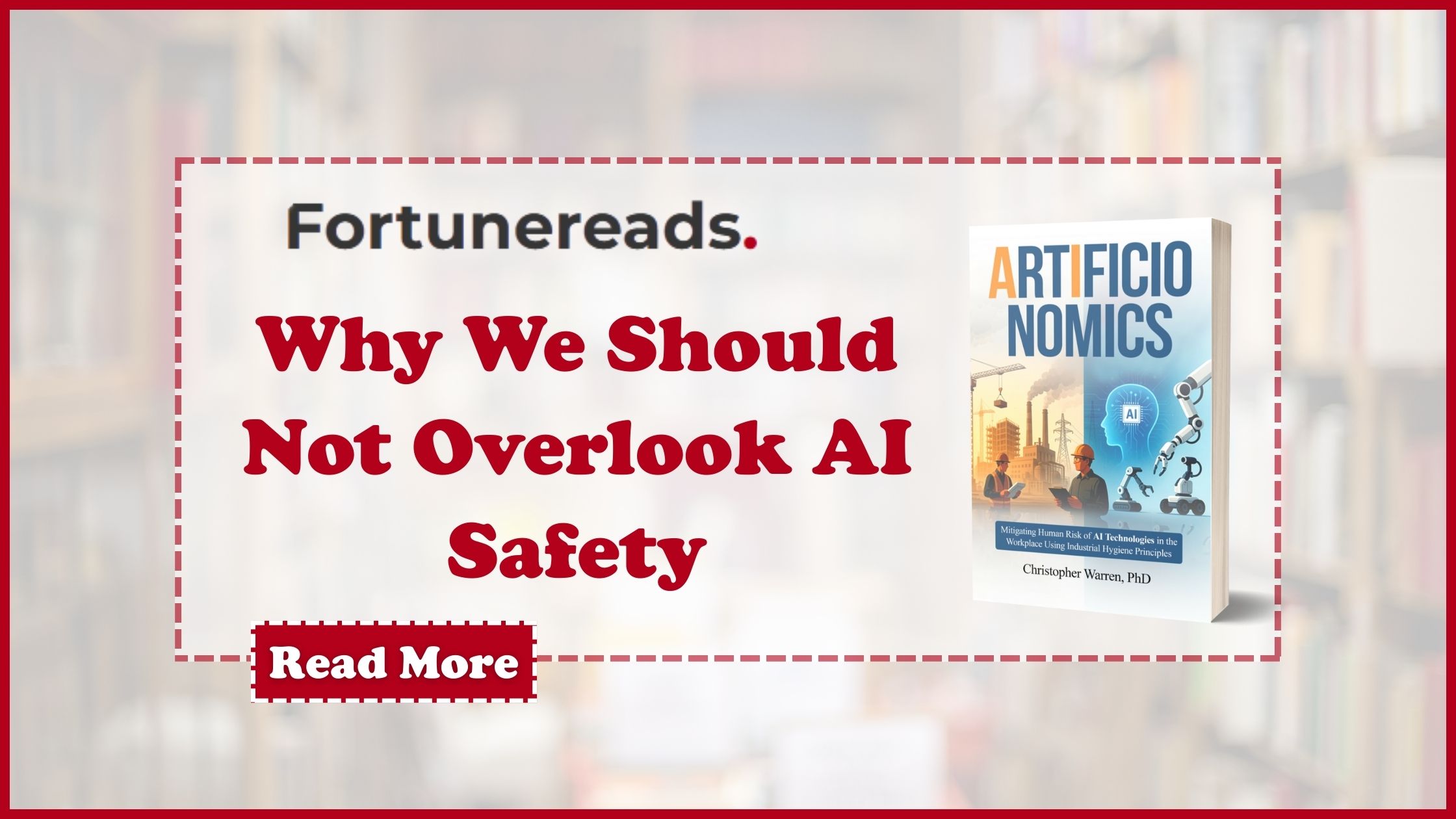
For more information and insight, please read Artificionomics: Mitigating Human Risk of AI Technologies in the Workplace Using Industrial Hygiene Principles. This book introduces a structured and practical framework for treating artificial intelligence as a workplace exposure, applying the same rigor used for chemical, physical, and psychosocial hazards.
Through real world case studies, regulatory analysis, and actionable assessment tools, Artificionomics equips safety professionals, organizational leaders, and policy makers to govern AI responsibly while protecting worker health, safety, and dignity.
For more details visit our website: https://artificionomics.com