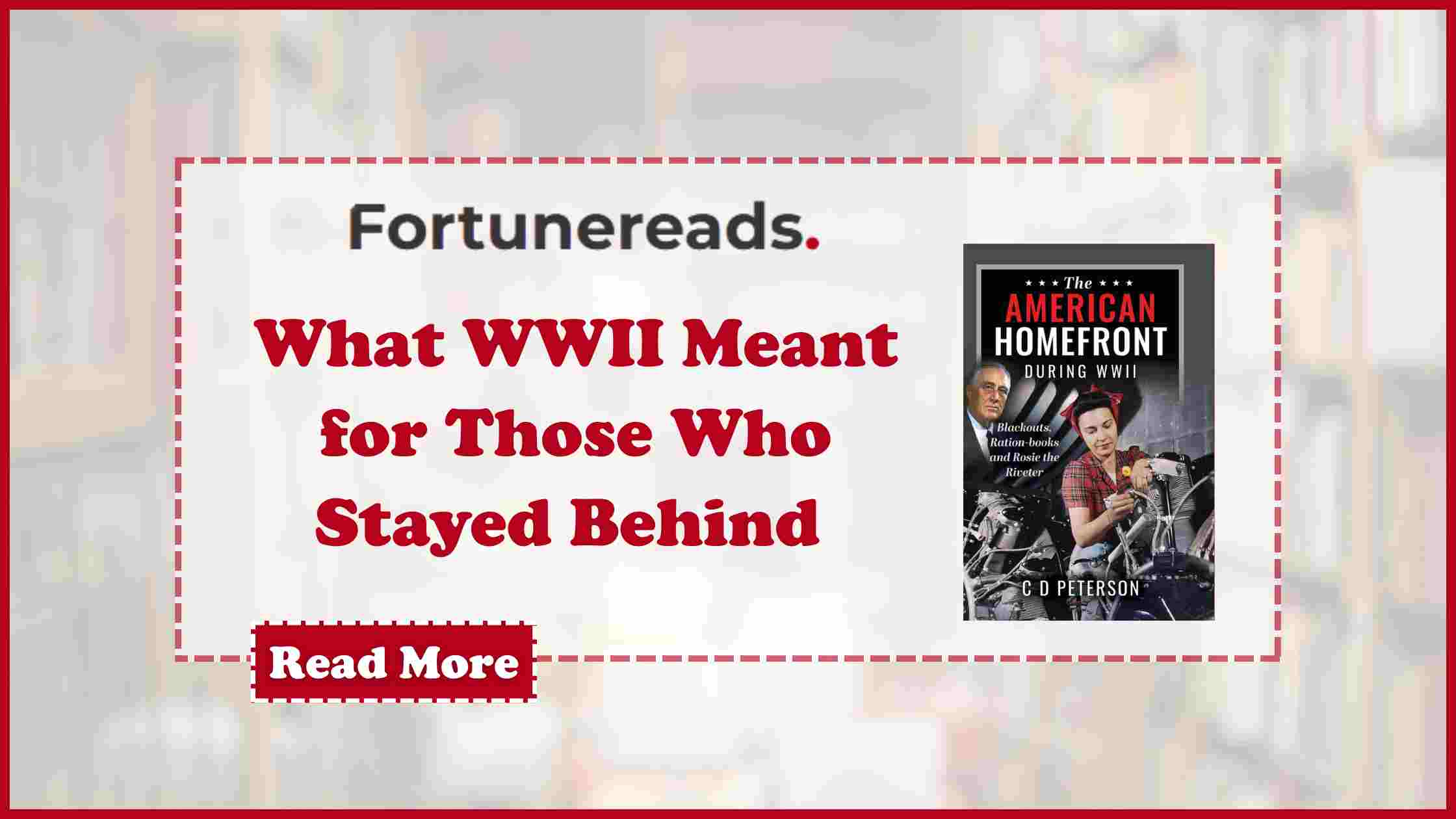
What does it mean to fight a war without ever stepping onto a battlefield? In America’s Home Front in WWII, C.D. Peterson answers that question with empathy, depth, and eye-opening detail. By presenting the United States during the war years, this book provides a human story of resilience, reinvention, and reckoning.
Peterson’s work is a panoramic portrait of the United States between 1941 and 1945. It focuses on generals and battles but also takes us into the homes, classrooms, factories, and neighborhoods of everyday Americans. With a storyteller’s voice and a historian’s discipline, the author is able to show how ordinary people kept the country going while the world was at war.
One of the first things that jumps out about the book is its structure. Each chapter tackles a different aspect of wartime life. Be it production, migration, women in the workforce, race relations, children, civil defense, or even entertainment, each of the different chapters and eras of World War II allows readers to go deep into each topic without overwhelming them. It also shows just how many facets of life were touched by the war.
Perhaps the most relatable chapter for many readers is the one about rationing. Due to a shortage of meat, sugar, and gas, Americans had to make the most of their money and come up with innovative ways to adapt. The pride families took in preserving scrap metal for bombs and airplanes, or the embarrassment kids felt when they couldn’t afford war stamps, are just two examples of how Peterson’s storytelling is unique because of the way he incorporates emotion. The details, which are both poignant and nostalgic, highlight how difficult daily life was for families.
Peterson is especially effective in capturing voices that are often left out of traditional war narratives. These include the women who went from housewives to welders, black Americans who saw both opportunity and injustice, and children who learned the language of war before they even understood what it meant. One particularly touching section describes how children learned to “black out” windows at night and save bacon grease for the war effort. These details and window into the past are memories passed down through generations, given full weight in Peterson’s hands.
The book also examines the darker corners of the home front. For example, we will experience the fear of saboteurs, the animosity toward Mexican American workers, and the Japanese internment camps.
That said, this is not a grim book. It’s full of humor, nostalgia, and small joys. We learn how songs, radio shows, baseball games, and movie theaters helped keep people and those who are on the frontline sane, and how neighborhood dances and street parades lifted spirits. Even the “Burma Shave” road signs make an appearance, as Peterson recreates the rhythms and quirks of 1940s America.
What’s most impressive is how relevant it all feels. Reading this book during a time of national stress reminds us that resilience does not always manifest itself in the form of headlines or heroic actions. Sometimes it’s a mother working three jobs. A schoolteacher who runs a day care. A child saves coins for a war bond. These stories abound on America’s Home Front during WWII, stick with you long after the book is closed.
In the end, C.D. Peterson doesn’t just chronicle a moment in history. Rather than focusing on what they might have done, how they would have handled it, or what it means to be a part of something bigger than oneself, he asks us to see ourselves in it. For anyone interested in how real people lived, worked, and endured during one of the most defining moments of the 20th century, this book is a must-read. Grab your copy on Amazon: https://www.amazon.com/dp/B0DDL1GXF2