For decades, Chinua Achebe has been celebrated primarily as the literary giant who challenged colonial stereotypes about Africa. His landmark novel, Things Fall Apart, is often taught as a powerful response to colonial narratives that portrayed African societies as primitive or uncivilized. While this reading remains important, it captures only part of Achebe’s intellectual legacy.
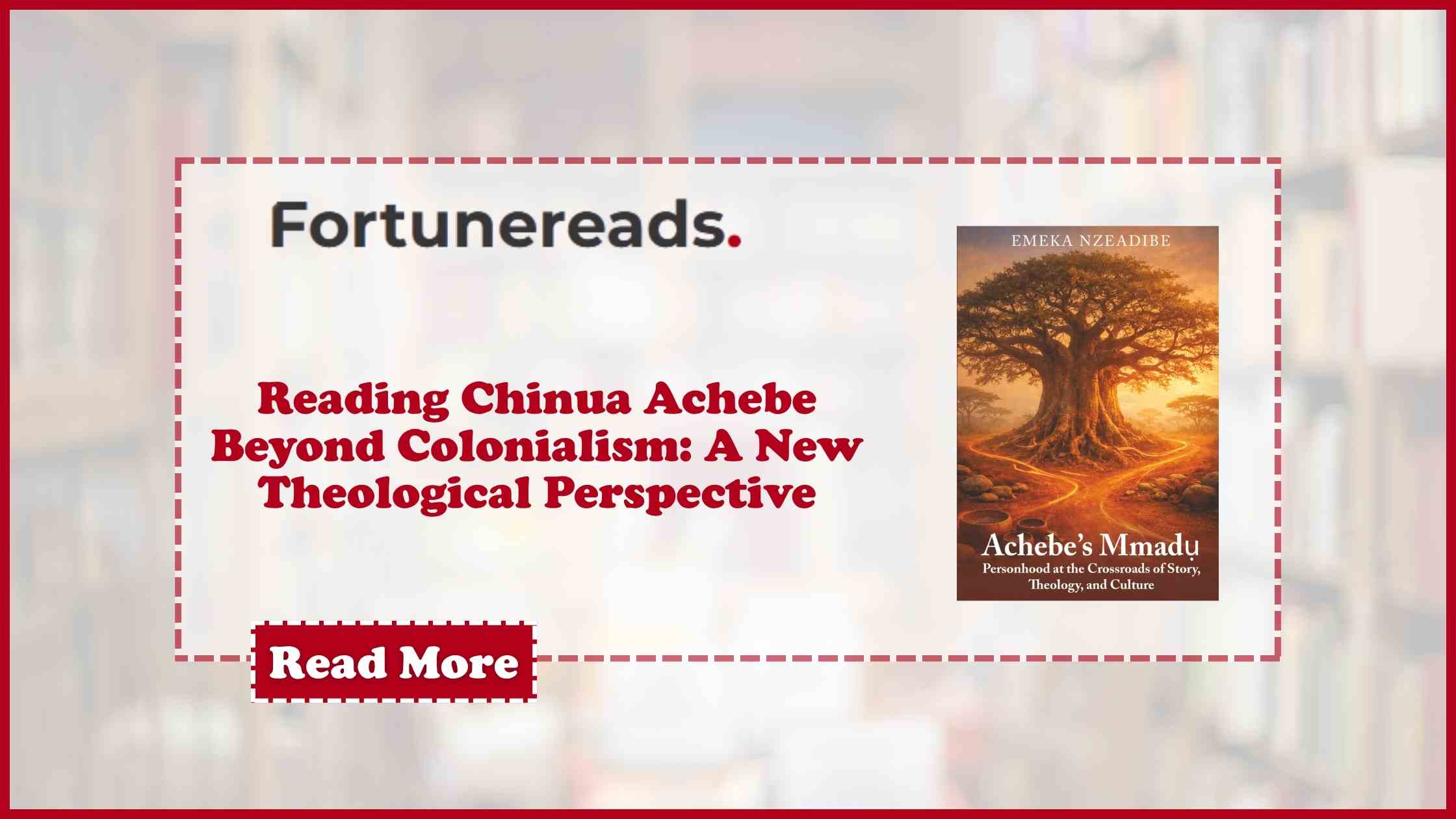
In Achebe’s Mmadụ: Personhood at the Crossroads of Story, Theology, and Culture, Emeka Nzeadibe invites readers to move beyond a strictly postcolonial interpretation of Achebe and encounter a deeper dimension of his work, one rooted in theology, philosophy and the profound African understanding of personhood.
At the heart of this perspective is the Igbo concept of Mmadụ, a term that means “human being” or “person,” but carries far richer implications. In Achebe’s literary world, a person is not merely an isolated individual defined by achievement, status or independence. Instead, personhood is relational, spiritual, communal and deeply interconnected with destiny, morality and the sacred order of existence.
This theological lens transforms how readers understand Achebe’s characters and communities. Figures like Okonkwo in Things Fall Apart or Ezeulu in Arrow of God are not simply victims of colonial disruption or symbols of cultural conflict. They are embodiments of deeper questions about identity, dignity, freedom, responsibility and what it truly means to be human within a living cosmos.
Achebe’s stories reveal an Igbo worldview where existence is never solitary. The famous Igbo saying, “Ife kwụrụ, ife akwụdebe ya,” “Where something stands, something else stands beside it,” captures the belief that all life exists in relationship. Humanity is understood through connection: connection to family, community, ancestors, spirit and destiny. In this sense, Achebe’s fiction becomes more than literature; it becomes a form of theological reflection on human existence itself.
What makes Nzeadibe’s work especially compelling is its effort to place Igbo thought into dialogue with broader theological and philosophical traditions. Rather than treating African cosmology as folklore or cultural curiosity, the book presents it as a serious intellectual framework capable of enriching global conversations about personhood and human dignity.
This perspective is particularly relevant today. Modern society often defines people by productivity, social status or individual success, leaving many feeling isolated and disconnected. Achebe’s vision of Mmadụ offers an alternative understanding of humanity, one grounded in relationship, belonging and shared existence. It reminds readers that human beings are not merely economic units or social identities, but persons whose dignity emerges through communion with others and the world around them.
Reading Achebe beyond colonialism does not diminish his political importance; rather, it deepens it. His work becomes not only a defense of African culture but also a profound meditation on the human condition. Through storytelling, Achebe preserves a worldview that challenges modern assumptions about identity, freedom and the meaning of being human.
In an era searching for deeper conversations about humanity and coexistence, Achebe’s voice remains urgently relevant. And through the scholarship of Emeka Nzeadibe, readers are invited to rediscover Achebe not just as a postcolonial writer, but as one of the most important theological and philosophical storytellers of our time.
Available On Amazon: https://www.amazon.com/dp/B0GZV57B1G/