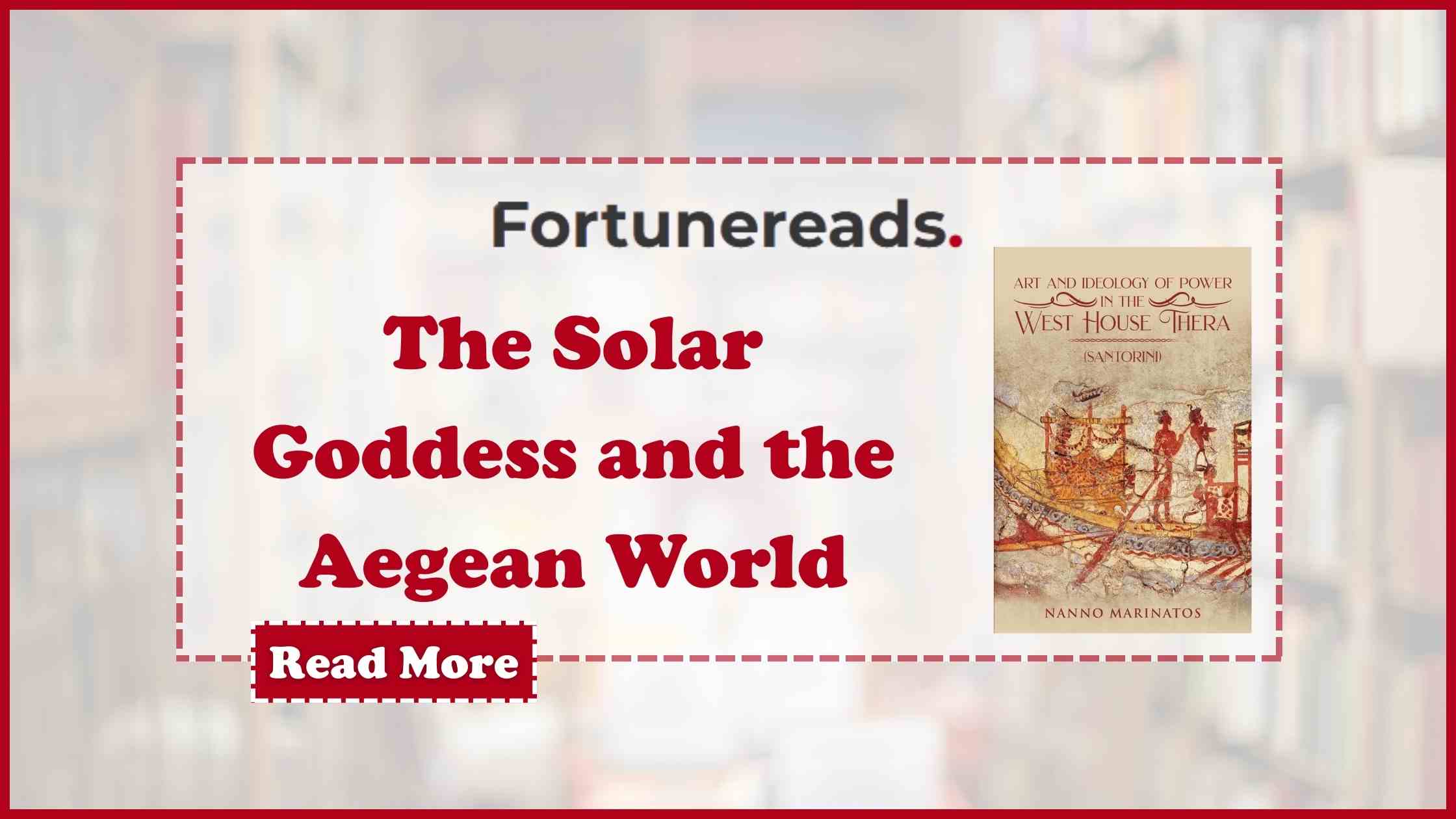
Across the ancient Aegean, the Minoans worshipped with colour, rhythm, and light. Their temples, frescoes, and artifacts reveal a civilization that saw divinity not in distant heavens but in the natural world around them. Central to this vision was a radiant figure, the Solar Goddess, whose presence symbolised life, order, and unity. In Art, Religion, and Ideology in the West House Paintings of Thera (Santorini), Nanno Marinatos revisits this remarkable worldview, exploring how the image of the Goddess linked art, religion, and political power in Bronze Age Crete and its surrounding islands.
The Solar Goddess was more than a myth; she was an expression of the balance between nature and humanity. Marinatos identifies her through recurring symbols found in the frescoes of Thera’s West House: the crocus flower, butterflies, lions, and above all, the sun. Each of these motifs appears not as decoration but as part of a coherent system of meaning. The crocus represents renewal and fertility, while the lions convey strength and divine protection. Together, they form a visual vocabulary of life under the light of the Goddess, whose power governed both nature and the affairs of people.
In the famous frescoes from the building known as Xeste 3, Marinatos describes a seated Goddess adorned with floral jewellery and surrounded by insects, birds, and blooming plants. Her dress is patterned with crocuses, and a tattoo of the same flower marks her face. The repetition of these images across the town’s murals, from household walls to ceremonial chambers, suggests a shared spiritual vision. The Goddess was not confined to temples; she was everywhere, representing the cycle of life and the warmth of the sun that made all things grow.
Marinatos’s study proposes that this Solar Goddess united both religion and politics in the Minoan world. Her symbols appeared on ships, jewellery, and architecture, connecting distant islands under a single faith. The fleet scenes from the West House, for example, depict ships adorned with crocus garlands and sun discs, explicit references to her blessing. These images conveyed a message of harmony and shared purpose across the Aegean, a phenomenon Marinatos refers to as a form of “visual colonization.” Instead of enforcing power through war, the Minoans used art to spread their ideology. Communities that accepted the symbols and rituals of the Solar Goddess became part of a peaceful but far-reaching cultural order.
This interpretation challenges the long-held image of the Minoans as an isolated or purely artistic society. Their art was not just decorative but communicative, a language that expressed unity, devotion, and identity. The Solar Goddess stood at the centre of this world, representing the sun as both a source of life and a symbol of divine authority.
Through Marinatos’s eyes, the Aegean becomes not a sea of islands, but a sacred landscape bound together by light, faith, and art. Her work invites readers to see that the roots of Western spirituality may lie not in temples of stone, but in painted walls that still glow with the warmth of a sun worshipped four thousand years ago.
To explore this vision further, read Art, Religion, and Ideology in the West House Paintings of Thera (Santorini) by Nanno Marinatos. This book redefines our understanding of the divine in ancient art and the enduring power of the Solar Goddess.
Don’t Miss Out – Grab Your Copy Today: www.amazon.com/dp/1970749369/