Leadership is emotional work, and pretending emotion has no place in performance would be ridiculous. But motivation becomes dangerous when we use it to avoid diagnosing what is actually wrong.
If a rep does not understand how to qualify an opportunity, motivation will not teach them. If a rep is working hard but pursuing the wrong accounts, motivation will not fix the strategy. If your team has six competing priorities and nobody knows which three actually matter, motivation may simply encourage them to run faster in six different directions.
Before you motivate the team, understand the problem.
Training for an IRONMAN 70.3 taught me something about motivation that leadership had been trying to teach me for years. There are obvious moments when you expect things to hurt. Race day is one of them. You know the wall is coming. You know there will be a moment when your body starts negotiating with you. But some of the hardest moments happen long before race day.
They happen on an ordinary Tuesday morning when the alarm goes off and nobody is watching.
There is no finish line, no crowd, and no medal. There is just the decision you already made and the work required to honor it.
Sales teams have Quiet Tuesdays too. That is where systems matter. That is where clarity matters. That is where standards, coaching, reinforcement, and accountability matter. A motivational speech cannot carry people through every ordinary Tuesday. Good leadership has to build something that can.
I spent years in the training industry, and I believed deeply in development. Then I sent one of my own top reps to training. The rep came back energized. The session was good. The ideas made sense. A few weeks later, very little had changed.
That experience forced me to confront something uncomfortable.
The training was not the problem. I was.
I had treated training like the finish line when it was actually the starting line.
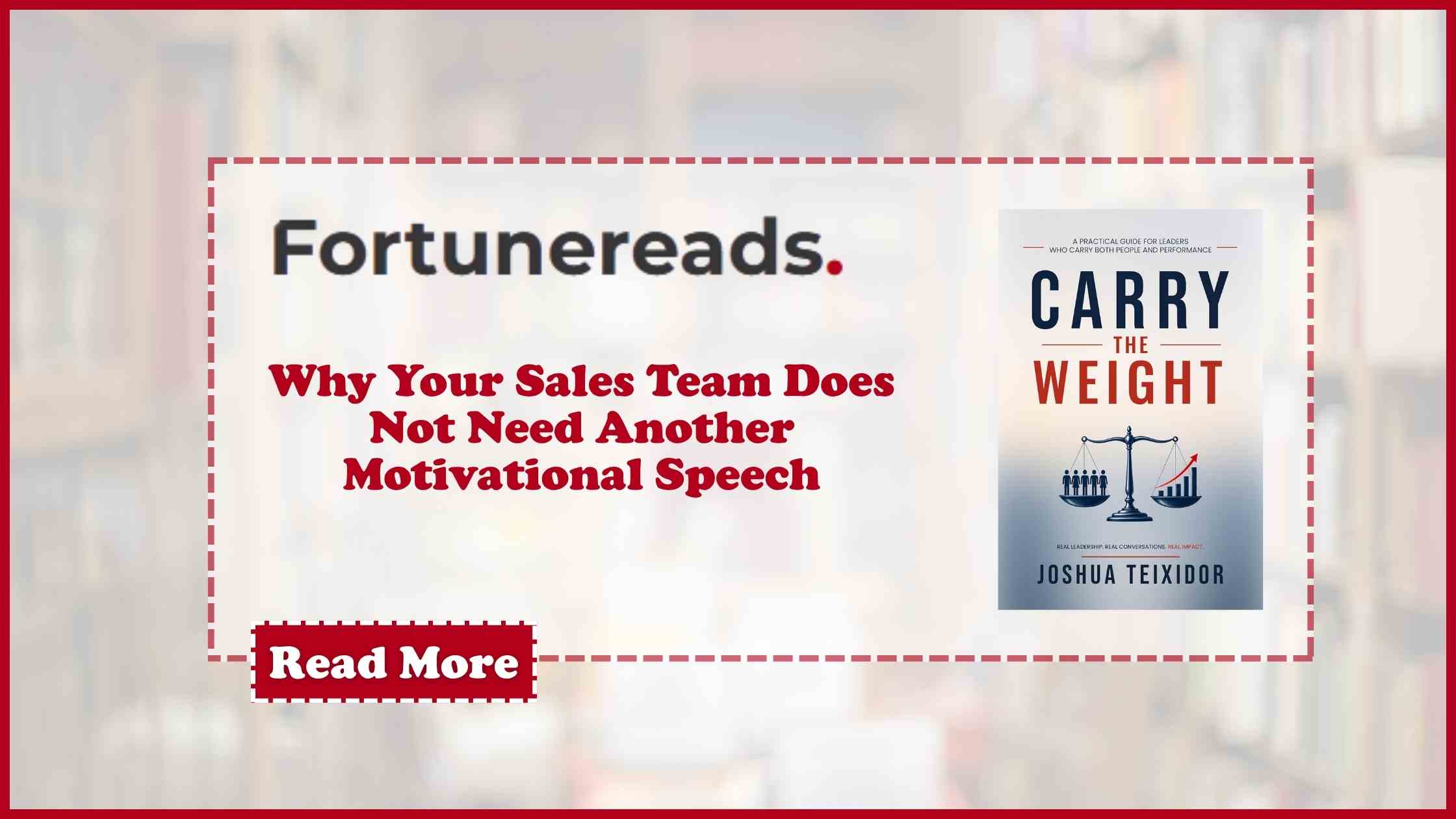
Knowledge matters, but knowledge without reinforcement and accountability rarely produces lasting performance. That became one of the core ideas behind Carry the Weight: The Sales Leader’s Guide to Coaching, Trust, and Building People Who Win.
I think about that through The Performance Equation: Knowledge × Reinforcement × Accountability = Performance That Lasts. If one of those elements disappears, another speech is not going to solve the problem.
When performance slips, leaders often feel pressure to do something visible. Motivation is visible. Clarity is quieter.
Clarity means telling people what matters now. It means defining what good looks like. It means deciding what the team should stop doing. It means having the conversation you have been avoiding. It means following up on commitments.
It also means diagnosing the problem before deciding what the person needs from you.
That is where EKS matters: Effort, Knowledge, Strategy. A struggling rep may be working hard but lack the knowledge to execute. They may have the knowledge but be pursuing the wrong strategy. Or the issue may be effort. Those problems require different responses.
Not every performance problem needs the same leadership response.
Sometimes someone needs encouragement. Sometimes they need coaching. Sometimes they need a clearer standard. Sometimes they need practice. Sometimes they need you to listen long enough to understand what has changed. And sometimes they already know what to do and need to be held accountable for doing it.
Leadership gets better when we stop giving everybody the same medicine.
That is why diagnosis matters. You cannot coach the right problem if you have not taken the time to understand it. You also cannot motivate your way around a broken system.
If priorities are unclear, fix the priorities. If people lack knowledge, teach them. If the strategy is wrong, change it. If commitments are repeatedly being missed, address accountability.
Motivation has a place, but it should never replace leadership.
The Growth Ladder is part of that same idea: development is not created by a single event. It is built through the work that happens after the lesson, after the meeting, and after the motivational speech has ended.
Your sales team does not need you to become less inspiring. They need you to become more intentional.
Give them belief and knowledge when they are missing. Help them rethink the strategy when the strategy is wrong. Reinforce what good looks like. Hold people accountable for the commitments they make.
The goal is to build an environment where people can perform when you are not standing in front of them reminding them to care.
If you are carrying a sales number while also trying to develop the people responsible for delivering it, Carry the Weight: The Sales Leader’s Guide to Coaching, Trust, and Building People Who Win was written for that exact tension. The book explores practical frameworks including EKS, OIRC, Three Hats: Manager, Coach, Leader, The Performance Equation, The Growth Ladder, and Quiet Tuesday.
Learn more at carrytheweightbook.com. For more insights on revenue leadership, sales management, and developing leaders, visit JoshuaTeixidor.com.
Also Available On Amazon: https://www.amazon.com/dp/B0HLL9GQL7