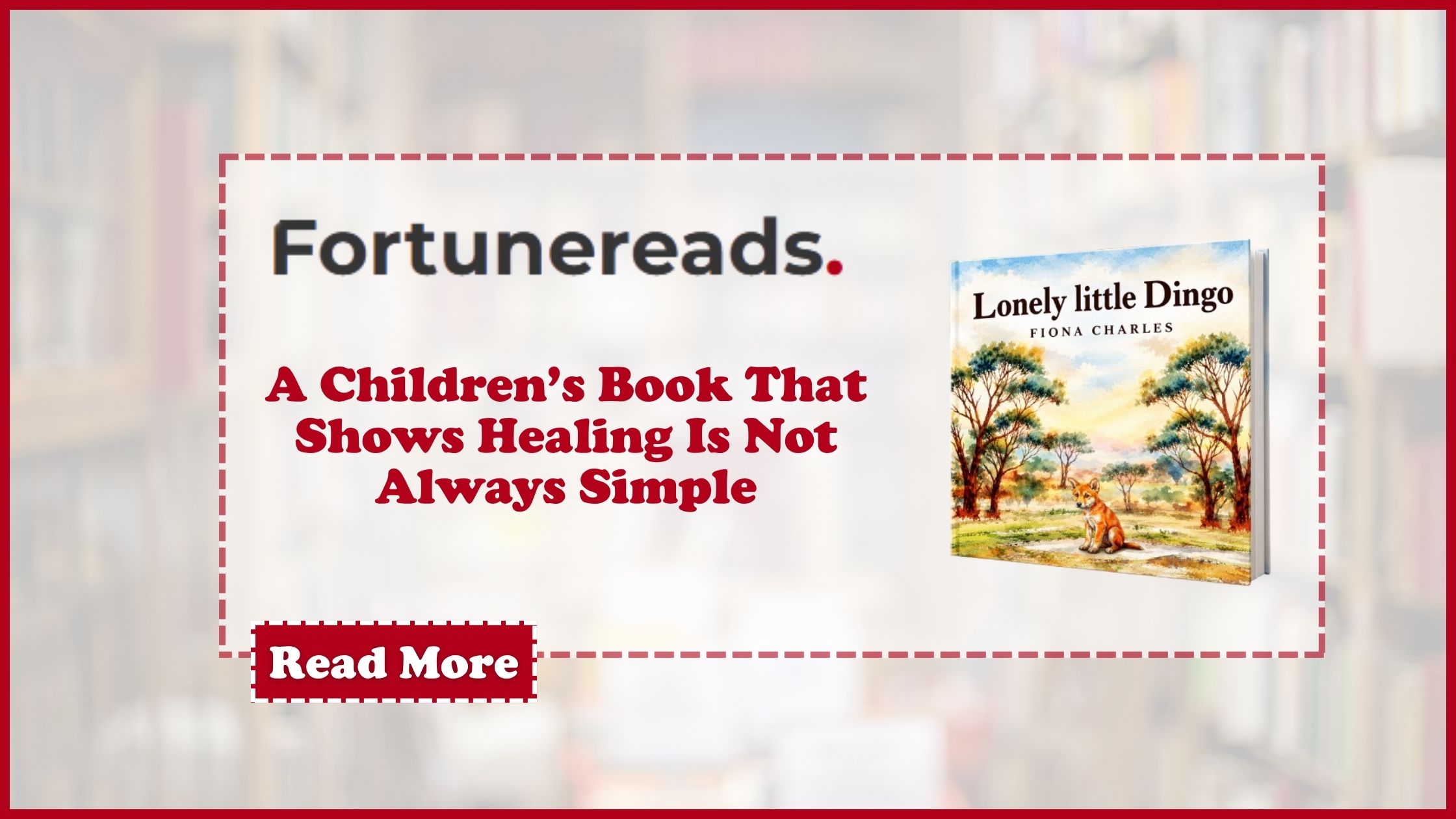
Children’s stories often present healing as a straight path: something bad happens, help arrives and everything becomes better. Fiona Charles’s Lonely Little Dingo takes a more thoughtful approach. Through the experiences of a vulnerable young dingo, the book shows that recovery can be complicated, emotional and gradual and that feeling safe again may take time.
From the beginning, Little Dingo’s world is filled with uncertainty. He opens his eyes beneath the Southern Cross in a crowded den, surrounded by other wild dogs but unsure who will care for him. His early experiences include growling, snapping, biting, hunger and repeated rejection. Instead of growing up with a clear sense of security, Little Dingo learns to be cautious.
As he gets older, however, he begins to discover another side of life. Venturing away from the den gives him room to explore, breathe and gain confidence. The environment outside feels calmer and each journey takes him farther from the chaos he has known.
Then a sudden accident changes everything.
Little Dingo becomes trapped and badly injured. Unable to run or move, he grows hungry, exhausted and weak. Eventually, unfamiliar hands rescue him and carry him to a warm, clean place where he can receive care.
At first glance, this might seem like the moment when everything should improve. Physically, it does. Little Dingo is fed, cleaned and given the chance to grow stronger. Emotionally, however, he is still afraid.
That distinction is what makes Lonely Little Dingo especially meaningful.
Even though his new carers are helping him, Little Dingo does not immediately trust them. He responds with hissing, bared teeth, destructive behavior and constant caution. His surroundings may have changed, but his memories have not.
The book later makes that emotional struggle even clearer. Little Dingo remembers the disorderly den, the biting and the growling. Those memories bring back sadness and anger, while part of him still longs to see the fractured family he came from.
For young readers, this can open an important conversation: healing does not always mean forgetting what happened. Sometimes a person or, in this story, a little dingo can be safer and stronger while still carrying fear, sadness or uncertainty.
Fiona Charles does not force Little Dingo into a perfectly tidy ending. Instead, she gives him something more realistic and, perhaps, more powerful.
By the final pages, Little Dingo is once again on his own beneath the familiar Southern Cross. His future is uncertain. He does not know exactly where he is going or what will happen next. But he keeps moving forward. The final line leaves him with one companion: hope.
That message also echoes the book’s dedication, where Charles writes, “I give you hope.”
With expressive illustrations, an Australian setting and an emotionally layered story, Lonely Little Dingo reminds children and adults alike that healing can involve fear, setbacks, memories, courage and uncertainty. Progress does not always mean feeling completely fearless. Sometimes, it simply means finding the strength to take the next step.
Lonely Little Dingo by Fiona Charles is available now on Amazon: https://www.amazon.com/dp/B0HLYCX8X3