For decades, healthcare systems have invested heavily in improving access, expanding coverage and advancing medical technology. Yet one persistent problem remains: the gap between what providers recommend and what patients actually do between clinical visits. This disconnect, often invisible in policy discussions, is one of the primary reasons chronic disease remains difficult to control and healthcare costs continue to rise.
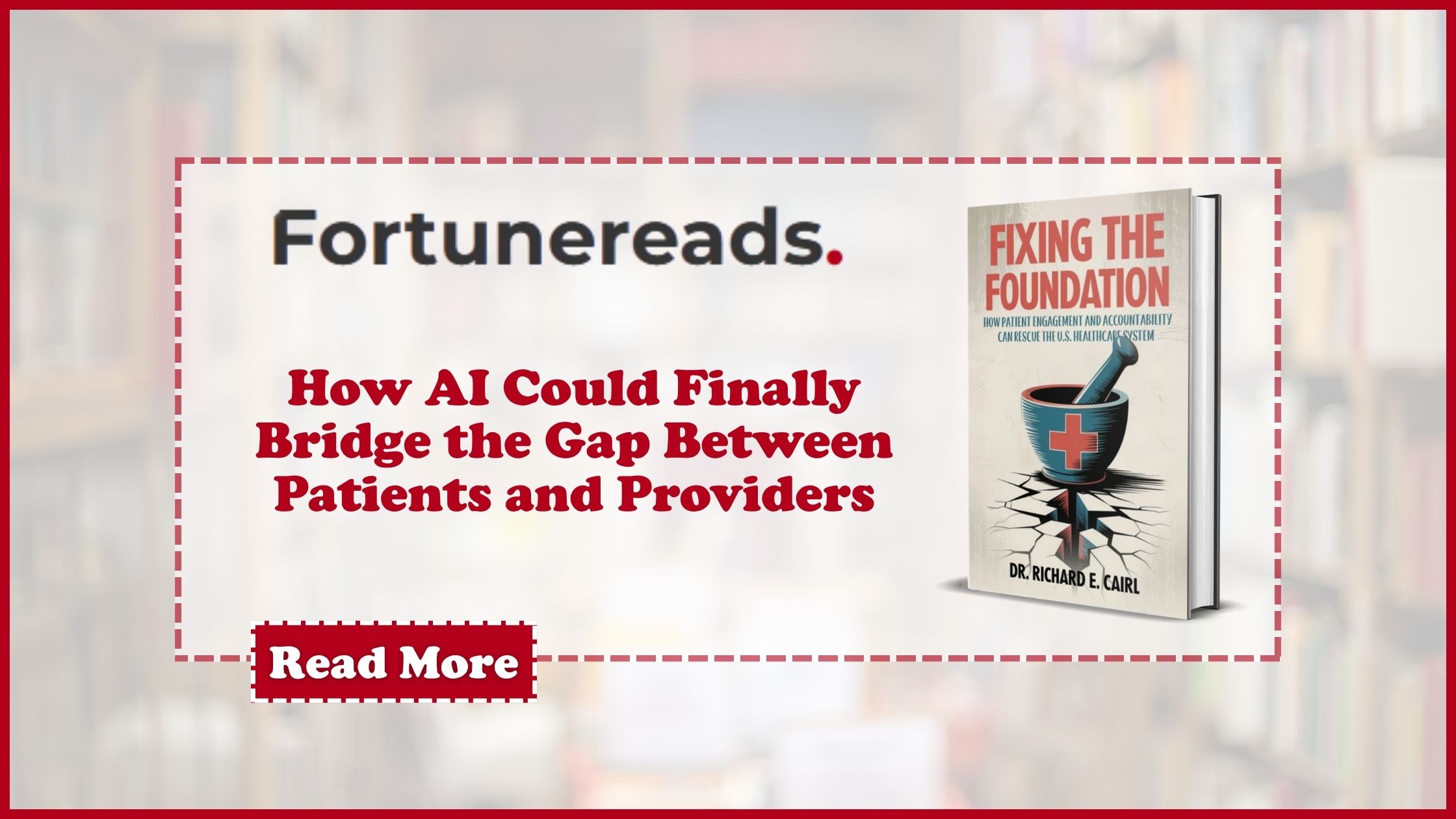
In Fixing the Foundation, Dr. Richard E. Cairl argues that meaningful healthcare reform depends on closing this gap through a fundamental shift in how care is designed. Increasingly, artificial intelligence (AI) and digital health tools are being positioned as powerful instruments to do just that, not by replacing clinicians, but by extending their reach into the daily lives of patients.
At the heart of the problem is timing. Healthcare is episodic, while health is continuous. A patient may spend 15 minutes with a provider discussing blood pressure, diabetes or heart failure, but the real determinants of success occur in the remaining 10,000+ minutes between visits. Medication adherence, dietary choices, physical activity, symptom monitoring and early response to warning signs all happen outside the clinic. Historically, providers have had limited visibility into this space and patients have had limited support within it.
AI changes this equation.
According to Dr. Cairl’s framework, conversational AI systems, remote monitoring tools and intelligent patient assistants can act as continuous “engagement bridges” between patients and providers. These tools can remind, guide, track and respond in real time, helping patients translate clinical instructions into daily behavior. More importantly, they can personalize support based on individual habits, barriers and patterns of risk.
For example, a patient managing hypertension may receive daily prompts to take medication, but also contextual feedback about diet, stress and activity patterns. A patient recovering from heart failure may be alerted when weight trends suggest fluid retention, prompting early intervention before hospitalization becomes necessary. In this model, AI does not simply deliver information; it helps operationalize care plans in real life.
However, Fixing the Foundation makes a critical distinction: AI is not a substitute for human accountability. It is a scaffold for it. Technology can enhance adherence, improve monitoring and reduce friction, but it cannot replace the human decisions that ultimately determine health outcomes. Patients still must engage, respond and act. Providers still must interpret, adjust and guide. The power of AI lies in making these interactions more continuous, timely and actionable.
This represents a shift from reactive healthcare to proactive partnership. Instead of waiting for deterioration to trigger intervention, AI-enabled systems can detect early signals of risk and prompt timely responses. Instead of relying solely on memory and motivation, patients can be supported with structured routines, simplified instructions and real-time feedback loops.
Crucially, Dr. Cairl emphasizes that the effectiveness of AI depends on embedding it within a broader framework of patient engagement and accountability. Without this foundation, technology risks becoming another layer of unused tools in an already fragmented system. With it, AI becomes a force multiplier for behavior change, continuity of care and shared responsibility.
The implications for healthcare reform are significant. If patient-provider communication can be extended beyond the clinic and if daily health decisions can be supported in real time, then many of the system’s most persistent problems, readmissions, poor chronic disease control and avoidable complications become more manageable.
Yet the goal is not technological replacement. It is relational enhancement. AI works best when it strengthens the connection between patients and providers, making care plans more understandable, more achievable and more responsive to real-life constraints.
Fixing the Foundation envisions a future where healthcare is no longer confined to appointments and prescriptions, but becomes a continuous, supported partnership. In this future, AI serves as the connective tissue between intention and action, helping transform medical advice into lived behavior.
Ultimately, the promise of AI in healthcare is not just smarter systems, but better alignment between knowledge and behavior. And in that alignment lies the potential to finally bridge one of healthcare’s most enduring gaps, the distance between providers who prescribe care and patients who live it.