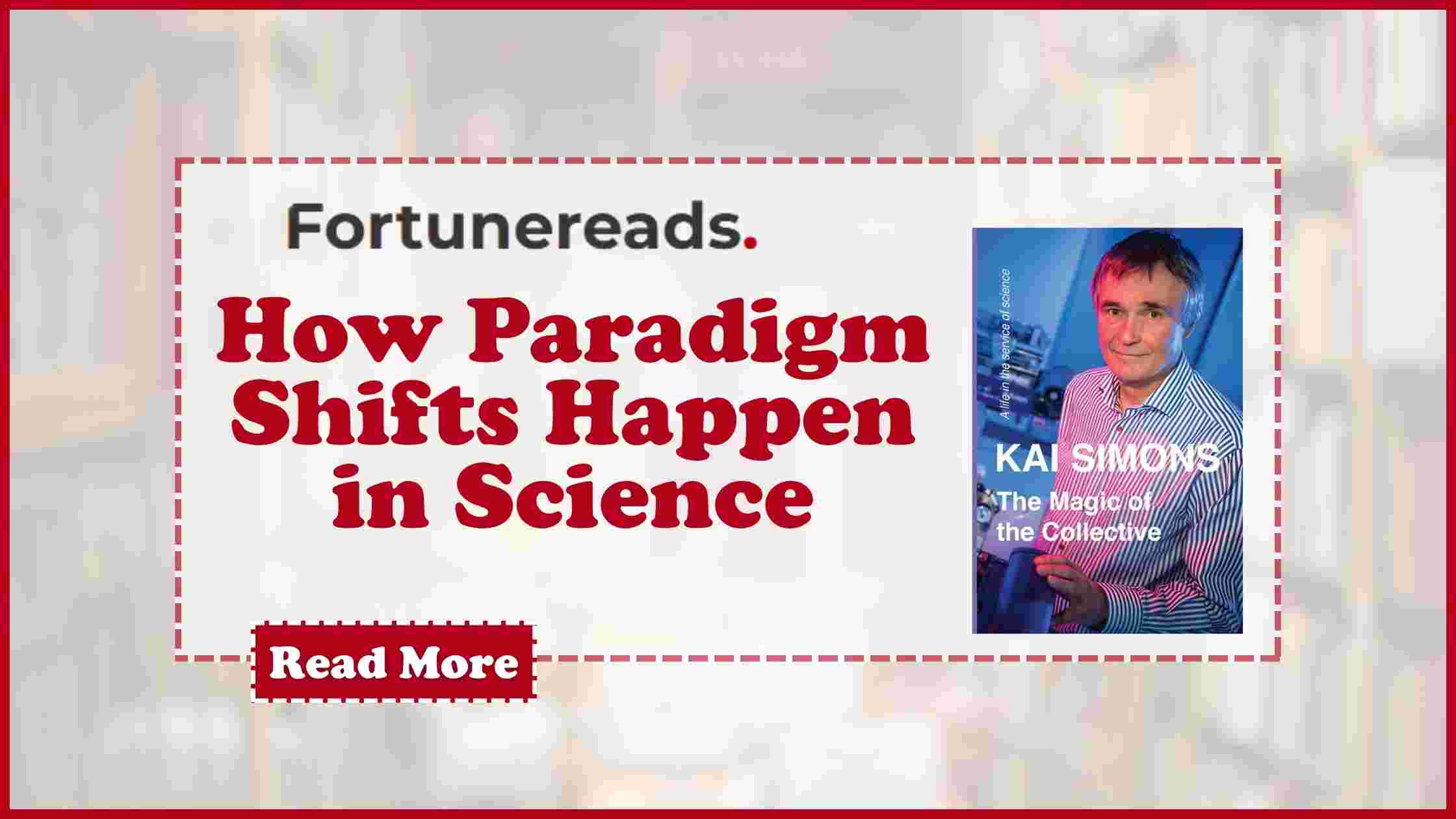
In The Magic of the Collective, Kai Simons highlights how science evolves through cooperation, persistence, and occasional rebellion against the status quo. His own experience with the lipid raft hypothesis serves as a case study in how paradigm shifts—fundamental changes in scientific understanding—happen.
What Is a Paradigm Shift?
The term “paradigm shift” was coined by philosopher Thomas Kuhn in his book The Structure of Scientific Revolutions (1962). A paradigm shift occurs when new discoveries force scientists to abandon or drastically revise long-standing theories.
Some famous paradigm shifts in science include:
- Heliocentrism replacing the Earth-centered model of the universe.
- Germ theory replacing miasma theory in medicine.
- Quantum mechanics challenging classical Newtonian physics.
Simons’ work on lipid rafts follows the same pattern: an idea that initially faced rejection later became a cornerstone of modern cell biology.
Why Do Scientists Resist New Ideas?
Paradigm shifts are rarely smooth. Scientists often resist new theories due to:
- Investment in Existing Models
- Many researchers build their careers on existing frameworks. Accepting a new theory can mean admitting past ideas were incomplete.
- Lack of Immediate Proof
- Game-changing ideas often emerge before technology can fully validate them. For lipid rafts, early experiments struggled to provide clear visualization.
- Scientific Culture and Competition
- As Simons describes in The Magic of the Collective, science is often structured around individual recognition rather than collective progress. This competition can slow the acceptance of revolutionary ideas.
What Drives a Paradigm Shift?
Despite resistance, paradigm shifts succeed when:
- New Evidence Accumulates
- Over time, more scientists replicate findings and develop better tools to confirm them. Lipid rafts became widely accepted as microscopy and lipid analysis techniques improved.
- Cross-Disciplinary Collaboration
- Many breakthroughs occur at the intersection of disciplines. Simons bridged biochemistry, cell biology, and physics to build a compelling case for lipid rafts.
- The Next Generation Adopts the Idea
- Older scientists often hold onto traditional models, but young researchers, free from career-long biases, embrace new ideas. This was key in the acceptance of the lipid raft theory.
The Future of Scientific Revolutions
Today, paradigm shifts continue in fields like artificial intelligence, synthetic biology, and climate science. Simons’ career exemplifies why bold thinkers are essential to progress, and why scientists must remain open to changing their perspectives.
Science is a self-correcting process, but as Simons argues, it needs a collective spirit to move forward. The next major breakthrough might be waiting for a new generation to challenge the status quo—just as Simons did.
Get Your Copy On Amazon: www.amazon.com/dp/1917007027