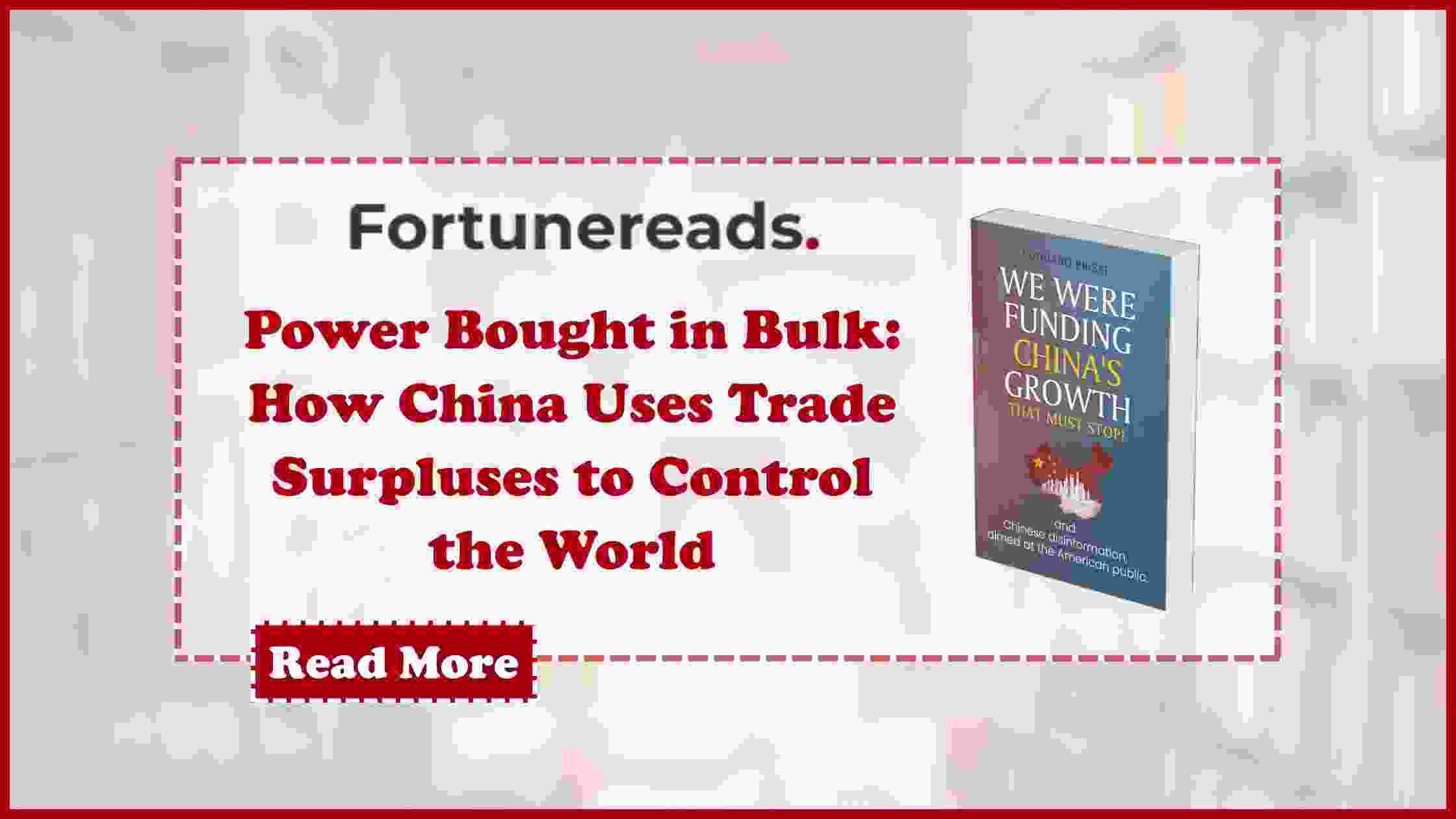
One of the central arguments of Edouard Prisse’s book is that the greatest danger posed by China today is not military aggression, but economic manipulation. The Chinese Communist Party, Prisse argues, has turned its massive trade surpluses into a global power-building tool—and the West, particularly the United States, has helped fund that power with every container ship of cheap goods it receives.
Since China’s admission into the World Trade Organization in 2001, its trade surplus with the United States and other Western nations has exploded. Each year, the West pours hundreds of billions of dollars into China in exchange for low-cost goods. These are often items with short lifespans—phones, clothing, gadgets—but the dollars used to buy them do not disappear. They accumulate in Beijing’s reserves.
Prisse estimates that China now holds over three trillion dollars in liquid foreign reserves and has spent well over seven trillion abroad. This vast stockpile allows China to project influence far beyond its borders. Where Western nations struggle to find funding for infrastructure or diplomacy, China opens the vault.
The most striking example is Sri Lanka. Beijing offered massive infrastructure loans that came with favorable terms—at first. When the projects failed to produce expected returns, China raised interest rates and eventually took control of key Sri Lankan assets, including a port. Prisse describes this as modern economic colonization, using debt to seize control. And he notes that the money China used for this came directly from Western trade.
Similar stories are unfolding in Africa, Southeast Asia, Eastern Europe, and even within the European Union, where nations like Greece and Hungary have been courted with Chinese investments. In exchange, these countries often soften their stance on Beijing’s human rights abuses or block unified EU responses to Chinese aggression.
This financial leverage also props up China’s own weak economy. According to Prisse, the Communist Party has built a command-and-control economy riddled with non-performing assets, failed real estate projects, and inefficient state-run firms. But the government avoids collapse by using trade surplus dollars to paper over deficits. Without the steady flow of money from the West, Prisse argues, China’s economic machine would stall.
The response from the United States has been inconsistent. Tariffs have been tried, but often at too low a rate to be effective. Policymakers treat the trade relationship as if it were balanced, while China continues to play a long game—subsidizing its industries, locking up foreign markets, and weaponizing its capital.
The solution, according to Prisse, is to end free trade and replace it with equal trade: no more imports from China than the U.S. exports in return. This would stop the enrichment cycle and begin to restore strategic balance.
Until that happens, every dollar spent at a discount store, every corporate supply chain tied to China, contributes not just to Chinese wealth—but to Chinese control. Prisse’s message is clear: economic power is real power. And we’re handing it to the wrong people.