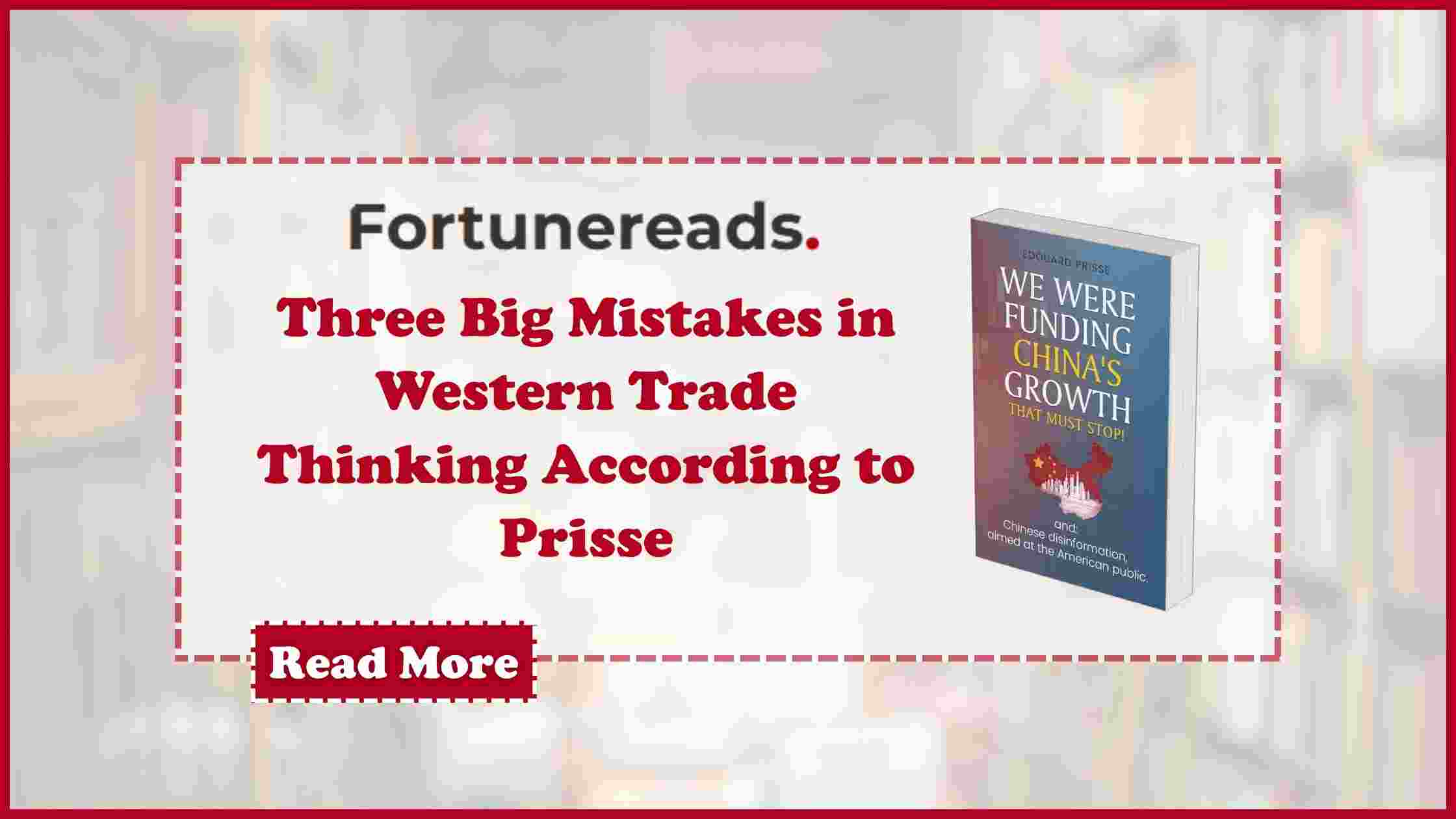
In his book We Are Funding China’s Growth That Must Stop!, Edouard Prisse outlines a damning indictment of the West’s economic relationship with China. Through historical reflection, economic analysis, and real-world examples, he identifies three fundamental mistakes that continue to define Western trade thinking—mistakes that, if left uncorrected, will hasten the decline of democratic power globally.
Mistake 1: Believing Free Trade Is Always Good
This is perhaps the most deeply rooted fallacy. As Prisse explains, free trade is not a universal good. It depends on the conditions under which it occurs. When both trading partners operate under similar rules—free markets, labor protections, environmental regulations—free trade fosters mutual benefit. But with China, these assumptions do not hold. The Chinese Communist Party suppresses wages, controls production, subsidizes state-owned enterprises, and violates intellectual property agreements. By treating China as a normal trading partner, the West enabled the rise of a state-driven, authoritarian economic powerhouse that now challenges the liberal order itself.
Prisse calls out President Clinton’s 2000 speech, in which Clinton championed China’s entry into the WTO on the belief that free trade would liberalize China. That prediction was disastrously wrong. Instead of reforming, Beijing exploited the openness of Western markets to enrich itself and tighten authoritarian control.
Mistake 2: Measuring Power by GDP, Not Liquid Assets
Western economists often use GDP as the yardstick for national power. But Prisse argues that this overlooks a crucial metric: how much money a state can actually spend. China’s $3 trillion in foreign exchange reserves give it enormous financial leverage, allowing it to outspend and out-influence nations with larger GDPs but less available capital. These reserves, funded largely by the trade surplus with the U.S., finance Chinese infrastructure projects abroad, debt-trap diplomacy, and strategic acquisitions. Meanwhile, the U.S. and EU have virtually no comparable reserve because they operate under very different economic systems.
This misunderstanding has led to miscalculations. Western leaders believe they are still in control because of nominal GDP dominance. But China’s ability to spend globally with few constraints has tipped the balance.
Mistake 3: Underestimating Authoritarian Strategy and Long-Term Planning
Western democracies often operate on short-term electoral cycles, corporate quarterly profits, and short-lived policy shifts. China, on the other hand, plays the long game. As Prisse shows through examples like the Belt and Road Initiative, port acquisitions in Europe, and disinformation campaigns in academia, Beijing thinks in decades, not quarters. The West’s failure to recognize this has allowed China to build deep influence networks while Western policymakers argue over minor tariff adjustments.
Prisse stresses that China’s authoritarian model thrives on Western confusion. It exploits short-term profit motives, buys elite silence, and uses economic interdependence as a weapon. The West’s mistake is not just misjudging China’s intentions—it’s failing to adapt to a fundamentally different kind of adversary.
Each of these three mistakes flows from a deeper problem: the unwillingness to rethink foundational assumptions. Edouard Prisse does more than just critique. He challenges policymakers, academics, and citizens alike to stop sleepwalking into economic subordination and to act decisively before the cost becomes irreversible.
This book is not just a warning—it’s a blueprint for strategic clarity. It’s time we listened.