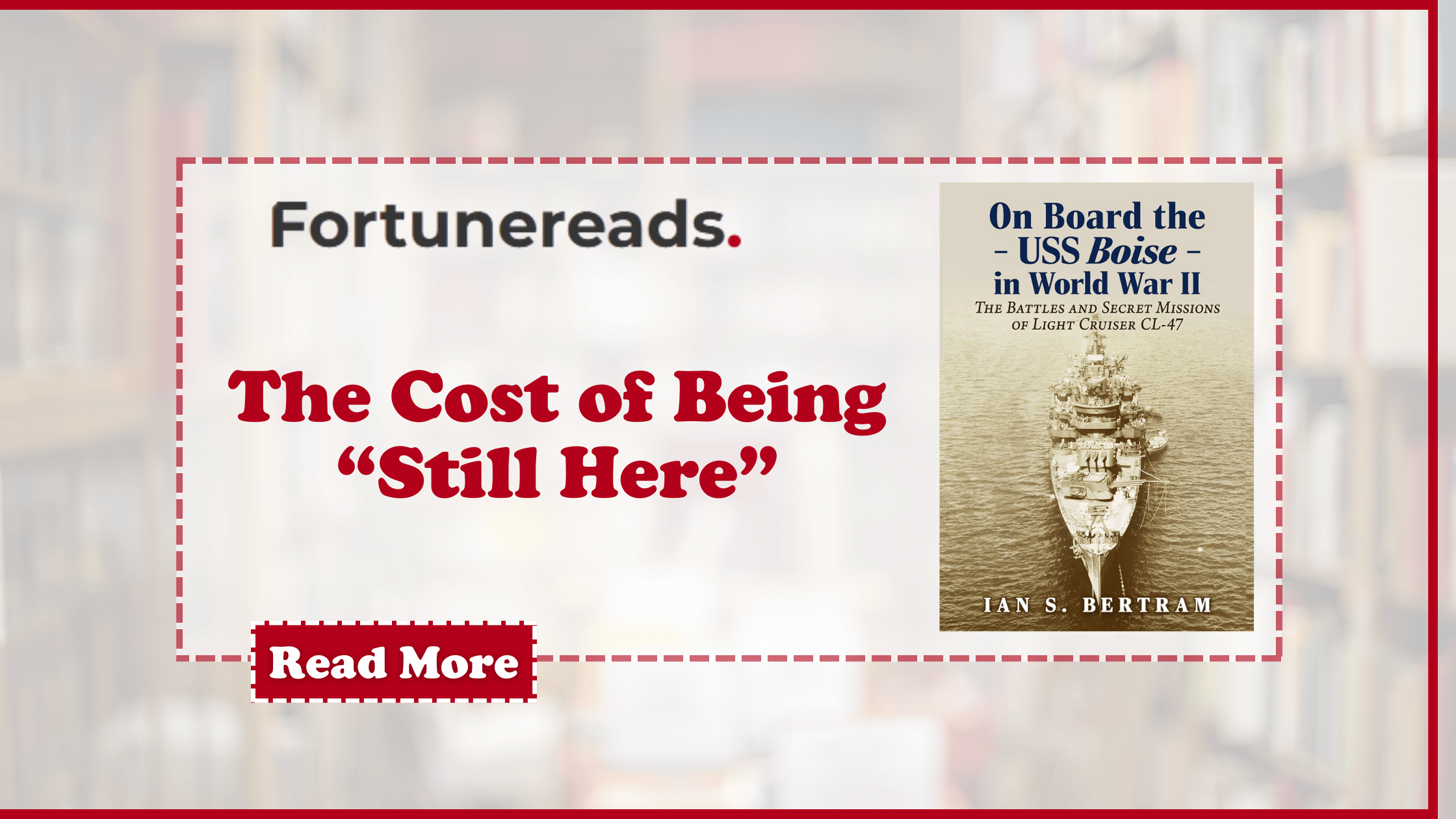
In On Board the USS Boise in World War II, a simple phrase appears again and again in Donald “DB” Fitch’s wartime log: “Still Here.” At first glance, the words seem almost casual. They suggest monotony, routine, perhaps even boredom. Yet as the months unfold and the Pacific War grows more violent, those two words take on deeper meaning.
When Boise slipped out of Manila Bay in December 1941, she did so as part of a shrinking Allied presence west of Pearl Harbor. Japanese forces were advancing rapidly across Southeast Asia. British capital ships had been sunk. American airpower in the Philippines was shattered. The improvised ABDA fleet was trying to hold back an enemy that appeared unstoppable.
Boise narrowly missed destruction in the Java Sea after running aground in treacherous waters. She was forced out of the line before the final clash that sent Houston, Perth, De Ruyter, and Java to the bottom. For the men aboard those ships, the cost was immediate and brutal. For the men aboard Boise, the cost was something different.
Some of the survivors of the Java Sea battle later referred to Boise as the “Reluctant Dragon.” In their eyes, the ship had escaped a fate that others met head on. Logic explained the grounding and the necessity of repairs. Emotion did not always accept it. In the years after the war, resentment lingered. The bitterness was not rooted in facts alone. It was rooted in loss.
For DB and his shipmates, being “still here” meant returning to duty while knowing that friends and fellow sailors were gone. It meant reading reports of prisoners of war marching into captivity. It meant hearing stories of ships that had fought until ammunition was gone and decks were awash with fire.
Boise endured repairs in Bombay carried out by her own crew working around the clock. She crossed oceans alone. She escorted vulnerable convoys. She was sent toward Japanese waters as a diversionary force, a single cruiser operating in radio silence, tasked with provoking a response from a superior enemy. Each voyage carried the possibility that “still here” might end abruptly.
The phrase also reflects the mental strain of sustained danger. The early Pacific War offered little stability. Submarine contacts interrupted meals. Air raid warnings disrupted sleep. Rumors filled the gaps where information was scarce. The crew drilled constantly in gunnery and damage control, knowing that one mistake could cost hundreds of lives.
The endurance to be “still here” came with a cost. Young men who boarded Boise in 1941 full of swagger and humor were tested in ways they could not have imagined. They learned how quickly steel can tear. They learned how fire spreads through compartments. They learned that survival can depend on the calm hands of a shipmate who knows his station.
DB’s log captures moments of liberty in Manila, Colombo, and Auckland. He saved menus. He joked. He danced. Those glimpses of normal life were not trivial. They were necessary. They were small acts of preservation in the face of a war that consumed entire fleets.
On Board the USS Boise in World War II does not present survival as triumph alone. It presents it as burden and responsibility. Boise lived to fight in later campaigns. Her crew continued into battles that would help turn the tide in the Pacific. But the cost of endurance never disappeared.
For every ship that sank, there were ships that survived long enough to see more combat, more danger, more loss. To remain afloat was to remain exposed.
The phrase “Still Here” becomes, in the end, a testament. It speaks to resilience, but also to the quiet weight borne by those who returned home when others did not. It reminds us that survival in war is never free.
In telling the story of DB Fitch and the USS Boise, this book honors not only the ships that were lost, but also the ships and sailors who carried on, who endured, and who bore the lasting cost of being still here.
Get Your Copy On Amazon https://www.amazon.com/dp/1476698074.