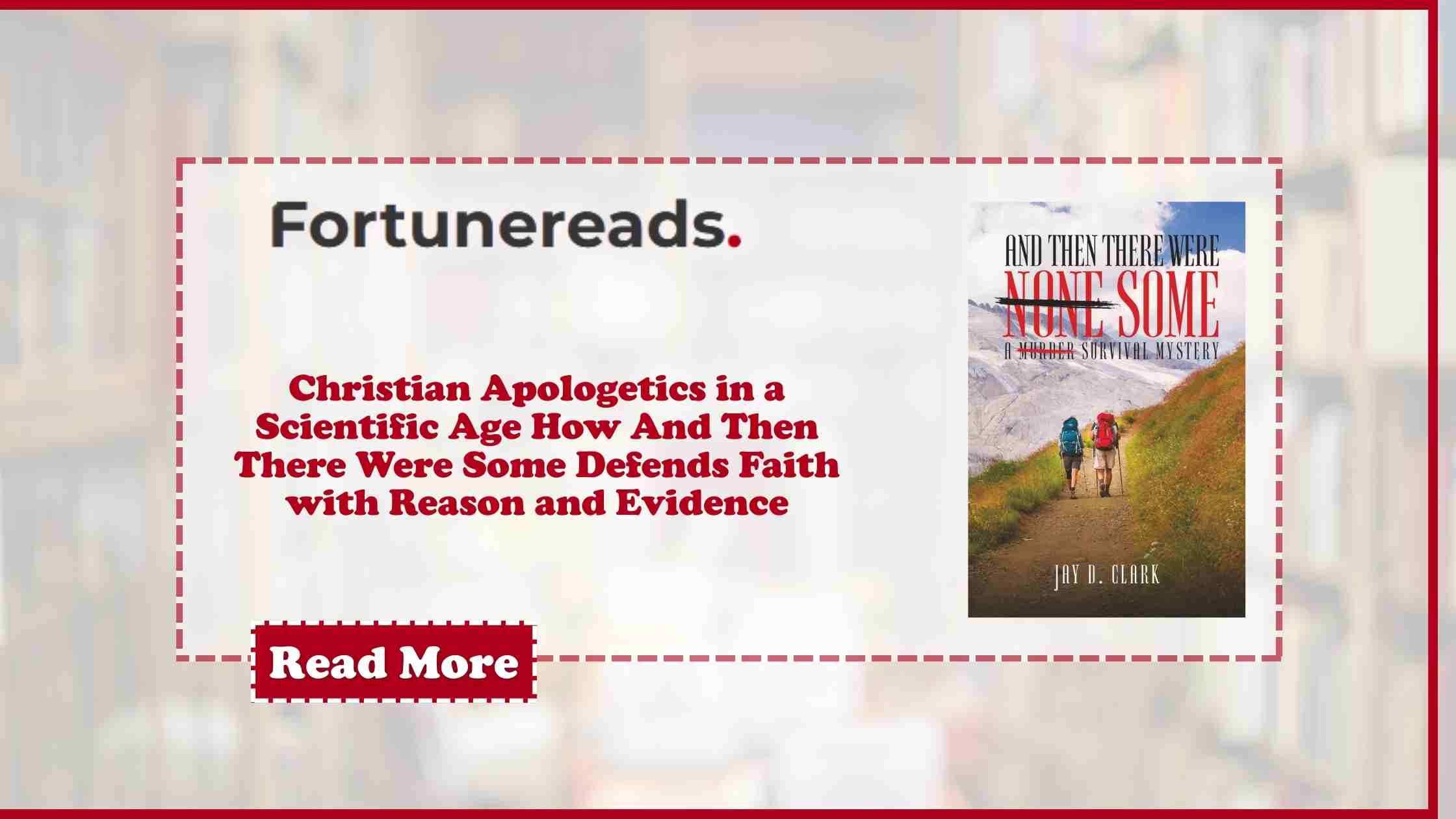
In a world increasingly driven by scientific discoveries and technological progress, is there still room for faith? Can belief in God survive under the microscope of modern inquiry? These are urgent questions for many, and And Then There Were Some: A Survival Mystery by Jay D. Clark offers a thoughtful and compelling answer.
Rather than framing faith and science as enemies, Clark shows how faith can stand alongside reason and even thrive because of it. By applying the same kind of evidence-based reasoning used in detective work, this book allows us to find the clues and use them to solve the biggest life mystery, to seek out the existence of God.
The need for Christian apologetics, or the defense of faith by reasoned argument and evidence, has never been greater, as skeptical voices often claim that belief is irrational or outdated. However, Clark demonstrates that many scientific discoveries actually strengthen the case for belief rather than weaken it. From the fine-tuning of the universe to the improbability of life arising by random chance, he draws from cosmology, physics, biology, and philosophy to build a robust case for theism.
Throughout the book, Clark uses abductive reasoning—the idea that the best explanation for a set of facts is likely to be true. Just as detectives gather clues and infer the most plausible scenario, we can look at the clues in nature and infer the existence of a Creator. The precision of physical constants, the ordered structure of DNA, and the moral intuition shared across humanity are not random accidents. They point to a mind behind the universe.
Clark also addresses common arguments from atheism and naturalism. For example, he carefully examines the Big Bang theory’s philosophical implications. A finite universe, which had a definite beginning, raises the question: What caused it? Since time, space, matter, and energy all began with the Big Bang, the cause must exist outside of all these. That sounds very much like the biblical description of God—a timeless, spaceless, immaterial Creator.
Importantly, Clark is careful not to claim that science alone “proves” God. Instead, he shows that scientific evidence, when viewed without bias, strongly supports a theistic worldview. In a world filled with data and discoveries, And Then There Were Some invites us to consider that belief in God is not only reasonable but is the best explanation for why anything exists at all.
In doing so, the book provides a roadmap for Christian apologetics today: honest, rational, humble, and evidence-based. It challenges readers, both believers and skeptics, to reconsider assumptions and follow the evidence wherever it leads.
In a scientific age that often prides itself on skepticism, And Then There Were Some reminds us that true skepticism does not mean rejecting all beliefs. Instead, it means rigorously testing ideas and accepting the ones best supported by reason and evidence. When we apply that method fairly, belief in God not only survives; it shines.
And Then There Were Some: A Survival Mystery explores the compatibility of science and faith, particularly Christianity, through an evidence-based approach. Drawing from science, history, philosophy, and scripture, Clark challenges the notion that faith and reason are incompatible. The book examines key Christian doctrines, refutes atheism, and presents historical and scientific evidence to support belief in God. It offers readers a thoughtful exploration of the relationship between science and religion, empowering us to defend our faith with rational, evidence-based arguments while providing reassurance that belief in God aligns with modern scientific understanding.
Get your copy on Amazon: www.amazon.com/dp/1917505191/.