
In the intellectual terrain of human development, intelligence has long been sliced into various measurable forms—logical, emotional, linguistic, and spatial. But what if one of the most powerful, yet unmeasured, intelligences is not how we solve problems but how we ask questions? Particularly, those questions that whisper late at night, “Why are we here?” “What happens when we die?” “Is there a larger purpose?”
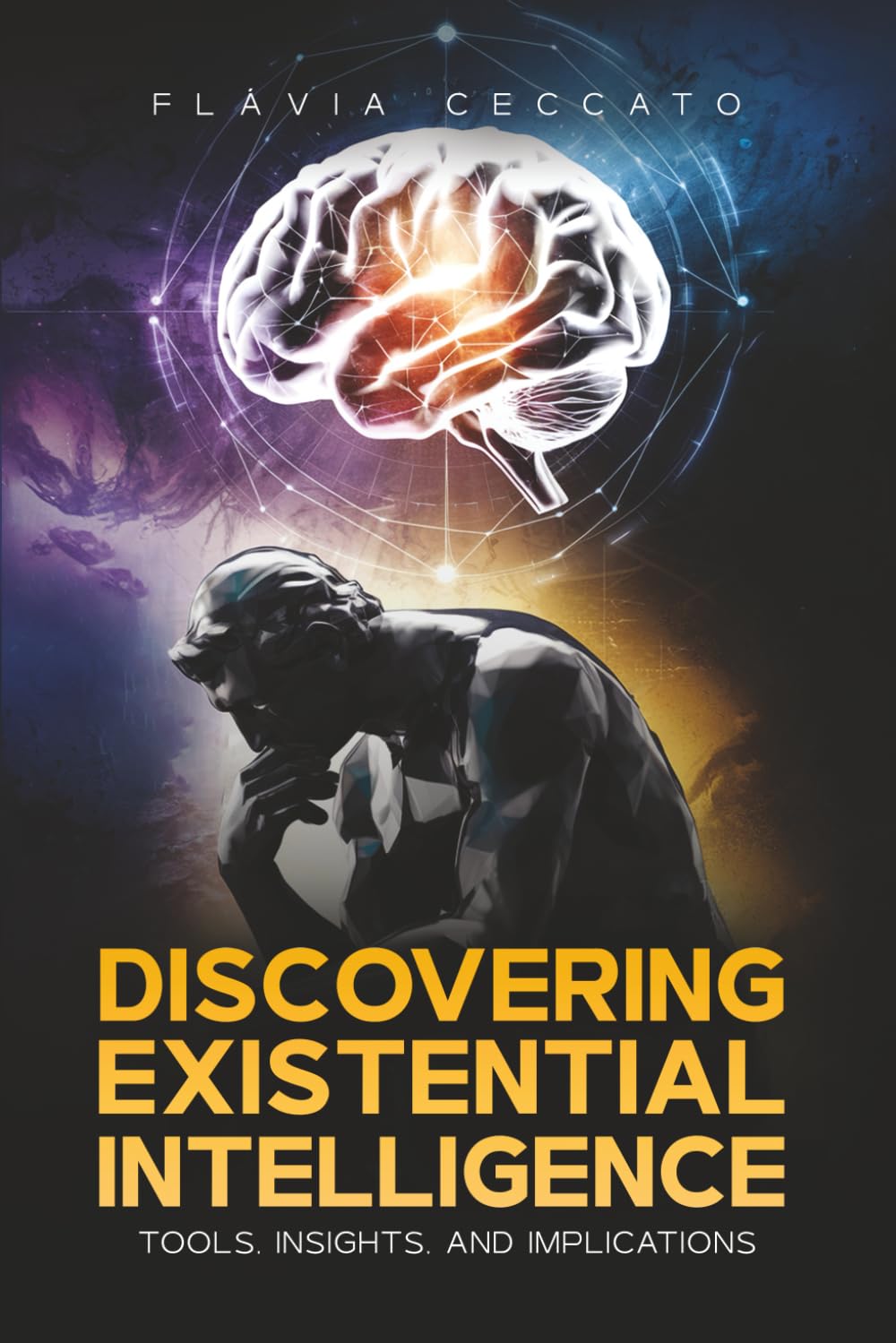
Flávia Ceccato’s Discovering Existential Intelligence presents an urgent case for recognizing and refining existential intelligence as a legitimate, cognitive domain that governs how humans reflect on the meaning of life, the nature of death, and their role in the universe. In doing so, Ceccato not only fills a gap in educational and psychological discourse but also sparks a necessary paradigm shift—where our deepest philosophical ponderings are no longer relegated to idle musings, but respected as a vital form of intelligence.
What Is Existential Intelligence?
Ceccato defines existential intelligence as the human capacity to confront and reason through life’s profound and unresolvable questions. Unlike spiritual intelligence, which often involves a connection to divine or religious belief systems, existential intelligence is rooted in reflection, observation, and critical thought. It is philosophical, not theological; introspective, not prescriptive.
This intelligence manifests when someone grapples with existential dilemmas such as: Is suffering necessary? What defines a meaningful life? Or Does morality exist beyond human perception? According to Ceccato, individuals who often contemplate such issues are not lost or directionless—they are engaging with a profound layer of consciousness that has been historically underappreciated.
The Academic Blind Spot
While Howard Gardner’s theory of multiple intelligences briefly hinted at existential intelligence as a “candidate” intelligence, it was left largely undefined in academia. Ceccato tackles this omission head-on, building a robust conceptual framework to measure and define it through a set of identifiable domains. These include:
Temporal-Spatial Awareness – Awareness of time, death, and existence on a cosmic scale.
Meaning-Oriented Reflection – Ability to derive personal or collective meaning from experiences.
Existential Sensitivity – Recognition of the emotional weight of existence, ambiguity, and mortality.
Moral-Ethical Reasoning – Engagement in moral inquiries rooted in existential awareness.
Through this structured lens, she elevates existential thought from passive daydreaming to an active mental discipline. Her proposal, in many ways, is radical: to bring existential intelligence into educational curricula and psychological assessments, right beside more “practical” forms of intelligence.
A Tool for the Modern World
In an era marked by anxiety, identity crises, and digital distractions, Ceccato’s proposition could not be more timely. The overemphasis on technical and emotional intelligence in corporate, academic, and developmental settings has left a vacuum—one that fails to address the existential despair many silently carry.
By cultivating existential intelligence, Ceccato argues, we can better equip individuals to navigate loss, adapt to change, question dogmas, and engage meaningfully with others. A society fluent in existential reasoning is more empathetic, resilient, and self-aware. It questions power and meaning, not just productivity.
Measuring the Immeasurable
Skeptics may argue that existential intelligence is too abstract to be measured. But Ceccato challenges this by designing indicators for its development. Through assessments, reflective exercises, and theoretical models, she demonstrates how educators, psychologists, and even spiritual counselors can detect and enhance this intelligence.
Her work doesn’t claim to answer life’s mysteries. Rather, it invites us to sit more comfortably with the questions. In doing so, it helps shift humanity’s mental model from “solving existence” to “exploring it.”